Haleakala Sunset Tour: The Summit Without the Sunrise Reservation
Do you need a reservation for Haleakala at sunset?
No. The mandatory recreation.gov reservation only applies to entries between 3 a.m. and 7 a.m. for sunrise. Sunset visitors skip that system entirely, but the park's standard per-vehicle entrance fee still applies and is valid for three days.
Why sunset is the other way up the mountain
Everyone hears about the Haleakala sunrise reservation before they hear about the mountain itself: a permit booked 60 days out on recreation.gov, a 3 a.m. alarm, and a drive up in the dark. Sunset is the alternative nobody advertises as loudly, and it solves the two most common complaints about the sunrise trip — the reservation scramble and the pre-dawn wake-up — without giving up much of the view. The summit of Haleakala sits at roughly 3,055 meters, above the clouds on most afternoons, and the light show at the end of the day plays out the same way it does at the start: color spreading across a volcanic landscape that looks more like erosion than a crater.
The reservation system that makes sunrise a planning exercise applies to one specific window: entries into the park between 3 a.m. and 7 a.m. Arrive at any other hour, including for sunset, and that system does not apply to you. That single fact changes the whole logistics of the visit, and it is the reason this guide exists as something separate from the sunrise playbook.
What the sunrise reservation covers, and why sunset skips it
The mandatory reservation exists because sunrise crowds at the summit outgrew the parking lots years ago. Recreation.gov releases the bookings 60 days in advance, with a small extra batch released two days before, and every vehicle entering during the 3 a.m. to 7 a.m. window needs one, on top of the park’s entrance fee. Miss that reservation and rangers turn cars away at the gate — there is no walk-up option for that time slot.
None of that machinery exists for the rest of the day. Drive up at 2 p.m. for a 6:45 p.m. sunset and there is no booking to make, no 60-day countdown, and no risk of a sold-out window. The tradeoff is that you are visiting on the same terms as every other daytime park visitor, which brings us to the part people get wrong next.
The fee that does not disappear
Skipping the sunrise reservation is sometimes read as skipping payment altogether, and that is the trap. Haleakala National Park still charges its standard per-vehicle entrance fee, and that fee applies at any hour, sunset included. It is valid for three consecutive days, which means a single payment can also cover a stop at the park’s separate Kipahulu district near Hana, since the two sections of the park do not connect by any road inside the park itself.
Budget for the entrance fee the same way you would for a sunrise trip. The only charge that disappears for a sunset visit is the recreation.gov reservation fee tied to the 3 a.m. to 7 a.m. window — nothing else changes.
| Sunrise visit | Sunset visit | |
|---|---|---|
| Recreation.gov reservation | Required, 60 days ahead | Not required |
| Park entrance fee | Charged, per vehicle, 3-day pass | Charged, same rate |
| Wake-up time | Roughly 2:30–3 a.m. | Normal afternoon departure |
| Drive down | In daylight | In the dark, headlights on |
| Crowd at overlooks | Heaviest at the two main lots | Spread out, still fills on clear evenings |
| Typical summit temperature | Near freezing | Near freezing once the sun drops |
The mountain itself
Haleakala is dormant, not extinct — it simply has not erupted in several centuries, and geologists don’t rule out a future eruption on a very long timescale. There is no lava anywhere on Maui today. The active lava on this part of the Hawaiian archipelago is on the Big Island, at Kilauea, inside Hawaii Volcanoes National Park, roughly a 40-minute flight from Maui. The two islands get confused constantly, and it’s worth being precise: what you’re standing on at the summit is a cooled, eroded landscape, not a live volcanic feature.
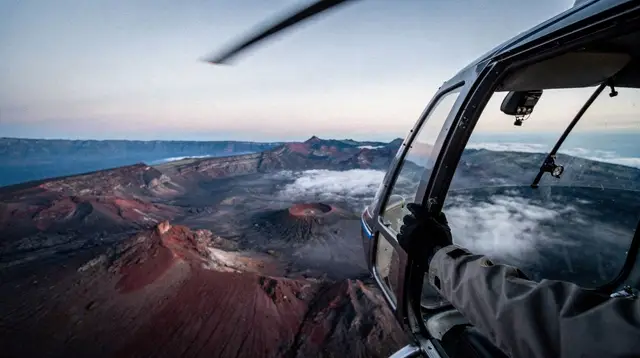
The “crater” itself is a common misnomer worth knowing before you look down into it. It’s technically an erosional valley, carved out over time by two streams cutting through the mountain, later reshaped by smaller volcanic activity inside it. That’s arguably a better story than the postcard version, and it explains the layered, striped coloring in the rock that catches the evening light so well.
What sunset actually looks like from the top
Where sunrise draws a crowd facing east into a single, fast burst of color as the sun clears the horizon, sunset is a slower build. The light moves across the valley below for close to an hour before the sun actually sets, turning the cinder cones red, then orange, then a deep purple as shadows stretch across the erosional valley. Because the summit often sits above the cloud layer, you can end up watching the sun sink into a sea of clouds below you rather than a normal horizon — a common enough sight here that regulars barely mention it, though first-timers usually do.
The overlooks near the visitor centers are the easiest vantage points and need no hiking. If you want something with fewer people, a short walk along one of the paved paths near the summit building gets you a clearer, more open view without committing to a real trail — save the longer descents for a full guide on crater hiking trails, since most of them assume daylight for the return leg and are not built around a sunset timeline.
Cold, altitude, and what to actually bring
The number that surprises people most is the temperature. Even in the middle of summer, the summit regularly drops close to freezing after sunset, and wind makes it feel colder still. This isn’t Maui beach weather at 3,055 meters — pack for it the way you’d pack for a cold mountain evening anywhere else: a real jacket, a hat, gloves, and closed shoes, not the flip-flops and swimsuit you wore that morning in Kihei. A full breakdown of layers and what actually holds up in the wind is in the guide to summit cold-weather gear.
Altitude is the other factor. At just over 3,000 meters, some visitors notice shortness of breath or lightheadedness, particularly if they’ve come straight up from sea level. It’s not a serious risk for a short evening visit for most people, but it is a real reason divers are told to wait at least 24 hours after a dive before heading up — the same rule that applies to the sunrise trip applies here.
Getting there and parking
The drive from Kahului to the summit runs close to two hours each way on the Haleakala Highway, climbing through Kula and the upcountry farmland before the switchbacks near the top. For a sunset visit, work backward from the actual sunset time rather than a fixed departure hour: aim to be parked at the summit visitor area 45 to 60 minutes before sunset, since the small lots near the top fill on clear evenings even without the sunrise crowd. There is no overflow lot at the summit itself, and rangers do not create one after dark. Details on where to park and which gate to use are covered in the parking and access guide.
The way down is the part self-drivers underestimate. You’ll be descending switchbacks in full darkness, headlights only, with no streetlights and the occasional cyclist or pedestrian near the visitor center parking areas. It’s manageable, but it is a genuinely different drive than the daylight descent that follows a sunrise visit.
Self-drive or guided
A guided evening tour removes the planning entirely: someone else times the drive, handles parking, and drives the switchbacks down after dark. Several run specifically around the sunset window, and most build in extras — snacks, blankets, or a stop for dinner — that make the cold and the long drive easier to deal with.
a small-group sunset tour up to the summit with snacks and photo stops built in is the straightforward version of this trip: transportation, timing, and the cold-weather logistics handled for you.
For a smaller, more private version of the same evening, a private sunset tour to the summit keeps the group to your own party rather than a shared van.
If you’d rather spend the evening on the mountain’s lower slopes instead of at the exposed summit, a guided llama trek on Haleakala’s flank at sunset is a genuinely different way to see the same light show, walking rather than driving to a viewpoint.
For an evening built around a meal as much as the view, a sunset tour to the national park that includes dinner pairs the drive up with a proper meal rather than snacks alone.
Self-driving costs less and gives you full control of timing, but it puts the night descent, the parking search, and the cold-weather packing entirely on you. Neither option is wrong — it depends on whether the drive down in the dark is something you want to handle yourself. A broader comparison of guided tours versus self-driving on Maui covers the tradeoff beyond just this one mountain.
Pairing sunset with the rest of Upcountry
Because there’s no pre-dawn wake-up attached to a sunset visit, the rest of the day is free for the upcountry side of the mountain: Kula’s farms, Makawao’s small-town streets, or a stop at a lavender or goat farm on the way up. That’s the practical advantage sunrise visitors don’t get — they’re driving up in the dark with nothing open along the way, while a sunset trip lets you build a full afternoon around the same drive.
If clear-sky viewing interests you beyond the sunset itself, some visitors stay past dark for the summit’s reputation as one of the best stargazing spots on the island, covered separately in the Haleakala stargazing guide. The park does close its access road at a set hour, though, so an extended stay after sunset needs to be planned rather than improvised.
Planning the rest of the trip
A sunset visit to Haleakala fits into a wider Maui itinerary more easily than a sunrise one does, since it doesn’t force an early bedtime the night before or a nap the day after. For the bigger picture on when to come and what else to build around it, see the best time to visit Maui and Maui weather by month, both useful before locking in a date for the summit.
If you’re deciding between the two summit experiences altogether, the sunrise guided tour versus self-drive guide lays out that comparison directly, and what to wear at the summit is worth reading regardless of which time of day you choose. For getting to and from the island in the first place, renting a car at OGG and whether you need a rental car in Maui cover the logistics that make either version of this trip possible. Rounding it out, the things to do near Haleakala hub lists other activities on this side of the island worth stacking onto the same day.
Haleakala sunset FAQ
Do I need to book a sunrise-style reservation to see the sunset at Haleakala?
No. The recreation.gov reservation system only controls entries between 3 a.m. and 7 a.m., which covers sunrise viewing. Driving up in the afternoon for sunset does not require that reservation.
Is entry to Haleakala National Park free for a sunset visit?
No. Skipping the sunrise reservation does not mean a free visit. The park’s standard entrance fee is charged per vehicle and is valid for three consecutive days, so it can also cover a Kipahulu stop near Hana on a separate day.
How cold does it get at the summit for sunset?
Temperatures often drop close to freezing after the sun goes down, especially with wind. It is noticeably colder than at sea level year-round, so a warm layer, hat, and gloves matter even in summer.
Is Haleakala an active volcano?
Haleakala is dormant, not extinct or active. It has not erupted in several centuries. There is no lava anywhere on Maui; active lava flows are on the Big Island’s Kilauea, roughly a 40-minute flight away.
What time should I arrive for sunset at the summit?
Plan to be at the summit visitor area at least 45 to 60 minutes before official sunset to find parking and a viewing spot, since the small lots fill on clear evenings and there is no overflow lot at the top.
Can I combine a sunset visit with hiking in the crater?
Only partially. Most crater trails require daylight and enough time to return before dark, so a sunset trip works better paired with a short overlook walk near the visitor center rather than a full descent into the crater.
Is a guided sunset tour worth it compared to driving up myself?
A guided tour removes the need to time the drive, find parking, and watch fuel and headlights on the way down in the dark. Self-driving costs less but leaves all of that timing and the night drive down to you.
Does the park entrance fee also work for the sunrise reservation?
The entrance fee and the sunrise reservation are two separate charges. The entrance fee lets a vehicle into the park; the sunrise reservation is an additional booking required only for the 3 a.m. to 7 a.m. window, and it is not needed for a sunset visit.
Haleakala volcano tours on GetYourGuide
Verified deep-linked GetYourGuide tours. Book through these links and we earn a small commission at no cost to you.
GetYourGuide does not provide a product photo for this activity — the image shows the meeting point, photographed by us.