Stargazing at Haleakala Summit: A Night Above the Clouds
Can you go stargazing at Haleakala summit at night?
Yes. The park stays open at night outside the 3-7 a.m. sunrise window, and the summit's 3,055 m altitude puts it above most cloud cover, far from city lights. No sunrise-style reservation is needed for a night visit, but the summit drops close to freezing after dark year-round, so cold-weather gear matters more than timing.
A different reason to drive up after dark
Most visitors who make the climb up the Haleakala Highway (Route 378, the only paved road to the summit) are chasing one specific thing: a permitted sunrise slot between 3 a.m. and 7 a.m. That reservation system, and the crowd it produces, has nothing to do with what happens up there on an ordinary clear night once the sunrise crowd has come and gone, or hours before it arrives. At 3,055 m, the summit sits above a meaningful share of the atmosphere and well clear of the light glow that washes out the sky over Kahului or Kihei. On a moonless night, that combination produces a sky dense enough that first-time visitors often stop mid-sentence.
This page is about that night sky, not the sunrise. For the permit system that governs the 3-7 a.m. window, see Haleakala sunrise reservation: how to book it, and for the background on why that system exists at all, see the history of the Haleakala sunrise reservation system. For the crater trails you’d hike during daylight, see Haleakala crater hiking trails. Neither of those applies here. A night visit for the stars is a separate outing with its own hours, its own gear list, and, notably, no lottery to win.
This guide covers Haleakala specifically, one of the six regions that make up Maui. If a night at the summit is one piece of a longer trip, how many days you need in Maui and Upcountry and Haleakala day tour planning are worth reading alongside this page.
Why the summit works for stargazing
Three things make Haleakala’s summit unusual as a place to look up:
- Altitude. At 3,055 m, you’re above roughly a third of the atmosphere’s mass and, more importantly, above the marine layer of clouds and haze that sits over the coast most evenings. That layer is the thing that makes coastal stargazing mediocre on Maui even on a clear-feeling night at sea level.
- Isolation from artificial light. The nearest real light sources are Kahului and Wailuku, both well below and several kilometers away across the isthmus. Kula and Makawao add some glow to the northwest, but the sky overhead and to the south stays genuinely dark on a clear night.
- Dry air. Upcountry and the summit sit largely above the trade-wind cloud deck, so the air overhead is often drier and steadier than at the coast, which means less atmospheric shimmer blurring faint stars and planets.
None of this is guaranteed on any given night. Cloud can build over the summit itself, particularly in the wet season from November to April, and a hazy or overcast evening cancels the view as completely as it would anywhere else. Checking the park’s current conditions and a general cloud forecast before driving up is worth the two minutes it takes. Maui’s weather by month gives a broader sense of which stretches of the year tend to run clearer, and best time to visit Maui covers the same seasonal split from a trip-planning angle. The wet season overlaps with the Pacific’s hurricane season, which runs June through November and can bring the kind of storm systems that rule out a summit drive entirely, not just cloud a summit view.
Stargazing hours vs. the sunrise window — the mistake to avoid
This is the single most common confusion about a Haleakala night visit, and it’s worth stating plainly: the 3 a.m. to 7 a.m. reservation system exists only to manage sunrise entries. It does not define when stargazing is possible, and it does not mean the summit is closed or restricted outside those hours for other purposes.
| Sunrise entry | Stargazing visit | |
|---|---|---|
| Reservation required | Yes, recreation.gov, booked up to 60 days ahead | No separate reservation |
| Time window | Vehicle entry 3 a.m.-7 a.m. only | Any hour the park road and gate allow |
| What you’re there for | The sunrise itself, over the crater | The night sky, generally before dawn twilight begins |
| Cost | Reservation fee plus standard 3-day park pass | Standard 3-day park pass only |
| Crowd level | Consistently full, arrive early for parking | Variable, usually far lighter |
A visitor who shows up at, say, 9 p.m. for stargazing is not in the reservation system at all and doesn’t need to be. Conversely, someone who has a 5 a.m. sunrise reservation and arrives at 3 a.m. often gets a genuine window of dark-sky viewing before twilight starts washing out the fainter stars around 5:30 to 6 a.m., depending on the time of year. The two experiences can overlap at the edges, but they are not the same booking, and treating the sunrise permit as a stargazing reservation — or assuming stargazing requires one — leads to either an unnecessary scramble for a permit or a wasted evening at the gate.
Confirm current gate hours and any night-access rules directly before planning a visit; they can shift with park staffing and season, and this page won’t try to print a number that goes stale. For the sunrise side of the mountain specifically, Haleakala sunrise: guided tour vs. self-drive and parking and access at Haleakala cover the logistics that don’t apply to a night stargazing trip.
The cold is the real obstacle, not the timing
Hawaii’s tropical reputation is exactly what trips people up here. Kihei might sit at a comfortable 26°C after sunset in the middle of winter, and it’s easy to assume some of that warmth carries up the mountain. It does not. The summit’s nighttime temperature regularly sits near or below freezing year-round, and that’s before wind is factored in, which is common and sharpens the chill considerably.
A short list of what actually works:
- A genuine winter coat, not a light jacket. Layers underneath: a base layer, a fleece or insulated mid-layer, and a windproof shell.
- A hat that covers the ears, and gloves. Extremities lose heat fastest at altitude and in wind.
- Long pants and closed shoes, not sandals or shorts, however warm the drive up from the coast felt.
- A blanket left in the car is a common local habit, useful both at the summit and for the drop back down before the car’s heater catches up.
- Altitude itself can cause mild shortness of breath or headache in some visitors; it’s rarely serious but is a reason to take the walk to a viewpoint slowly, and a reason this trip is not recommended within 24 hours of a scuba dive.
None of this is optional decoration. Underestimating the cold is the second most common mistake on this page, right behind confusing the sunrise window with stargazing hours, and it’s the one that actually ruins an otherwise clear night — nobody enjoys a dark sky while shivering in a t-shirt. What to wear at the Haleakala summit’s cold goes through the layering list in more detail, and a general Maui packing list is worth checking before the trip so the warm layer isn’t left at home entirely.
What you’ll actually see
On a clear, moonless night, the summit offers naked-eye views of the Milky Way’s band stretching across the sky, a level of detail rarely available from anywhere reachable by paved road in the continental United States. The southern sky, unobstructed by the light pollution that sits north over the isthmus towns, tends to be the most rewarding direction to look. Planets are visible without a telescope depending on the season, and even a modest pair of binoculars will resolve detail in the Milky Way’s dust lanes and star clusters that the naked eye smooths over.
Moon phase matters more than almost anything else. A full or near-full moon washes out the fainter structure of the Milky Way considerably, though it still makes for dramatic, well-lit summit scenery. Checking the lunar calendar before choosing a date is a simple way to set expectations, particularly for anyone specifically chasing the Milky Way rather than general stargazing.
There is no public telescope program at the Haleakala Visitor Center itself, and no expectation of astronomer-led public viewing nights built into a standard park visit. A few research observatories sit at the true summit within the restricted “Science City” area, which is closed to the public — those facilities are not part of any visitor stargazing experience, and no tour or self-drive visit gets access to them.
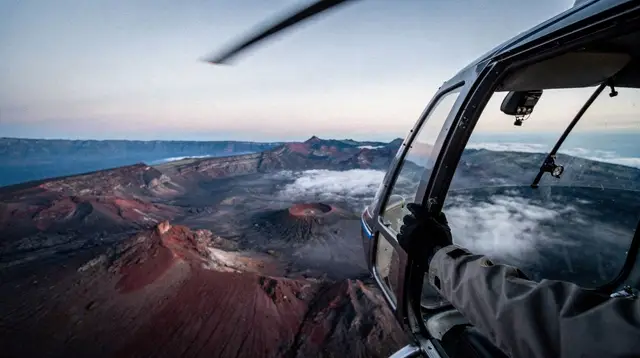
Daytime visitors to the same summit come for a different view entirely: the volcanic crater itself, covered in Haleakala crater hiking trails, or a wider look from above on a Haleakala crater helicopter tour. Neither substitutes for a night visit, but both explain why this same mountain draws visitors around the clock.
Guided vs. self-drive for a night visit
A self-drive night visit is straightforward logistically: no reservation to navigate, just the standard park entry pass, a full tank of gas, and the drive up in the dark, which is worth taking slowly given the road’s switchbacks and occasional wandering cattle or nene (the native goose) near the shoulder. Do you need a rental car in Maui explains why a self-drive summit visit specifically requires one, since the Maui Bus does not serve the summit at any hour.
A guided evening tour adds a few things a self-drive trip doesn’t: a portable telescope and someone who can point out constellations and explain what you’re looking at, snacks and hot drinks that make the cold more bearable, and often a stop for sunset photography before full darkness sets in, folding two experiences — sunset and stars — into one outing without two separate drives up the mountain.
A small-group evening tour that combines summit sunset with warm snacks and guided photo stops as the sky darkens is built around exactly that transition from dusk into night. For a more private version of the same idea, a private evening excursion to the summit keeps the pace and stops flexible for a smaller group. Travelers who’d rather spend the descent on the back of an animal than in a car seat can look at a guided llama trek on Haleakala’s slopes timed around sunset, which covers the same upcountry terrain at a slower pace before dark. And for those who want the mountain in daylight instead, without the sunrise crowd, a self-guided daytime bike descent from the upper slopes is worth pairing with a separate, later return for the stars.
Planning the visit
- Access: The Haleakala Highway (Route 378, connecting from 377 and 37) is the only road to the summit. From Kahului, plan roughly two hours of driving time, more if you’re coming from West Maui or the south.
- Fuel and supplies: There are no services at or near the summit. Fill up in Kula or Pukalani before the final climb, and bring water — the dry air at altitude is dehydrating.
- Park pass: A standard three-day Haleakala National Park entry pass, sold per vehicle, covers a night stargazing visit. No sunrise-style reservation applies outside the 3-7 a.m. window.
- Best conditions: Clear skies, a new or crescent moon, and minimal wind. Checking a short-range cloud and wind forecast for the summit specifically — not just Kahului’s — avoids a wasted drive.
- Timing within the night: Full darkness after nautical twilight ends offers the best contrast; exact times shift by season, so a quick check of local sunset and twilight times for the date of the visit is more reliable than a fixed clock time.
- Combine with an early sunrise reservation: If you already hold a 3 a.m. entry for sunrise, arriving right at that window gives a stretch of dark sky before dawn twilight begins to lighten things around 5:30 to 6 a.m.
- Pair it with the rest of Upcountry: Kula and Makawao, on the drive up, are worth daylight time of their own — see Upcountry farm tours in Kula for lavender and goat farms along the same road.
A night visit like this slots naturally into a longer stay rather than a single-day trip. Seven days in Maui: the complete itinerary and seven days of Maui adventure and hiking both leave room for an Upcountry evening without crowding out the coast.
Stargazing at Haleakala: frequently asked questions
Do I need a reservation to go stargazing at Haleakala at night?
No. The reservation system on recreation.gov only controls entries between 3 a.m. and 7 a.m. for sunrise. A stargazing visit outside that window needs only the standard three-day park entry pass, sold per vehicle.
How cold does it get at Haleakala summit at night?
Nighttime temperatures at 3,055 m regularly sit near or below freezing, even in summer, and wind makes it feel colder. Bring a winter coat, hat, and gloves regardless of how warm the coast was that day.
Is Haleakala a good place to see the Milky Way?
Yes. The summit sits above roughly 30 to 40 percent of the atmosphere and far from major light pollution, giving unusually dark, stable skies. Clear, moonless nights offer some of the best naked-eye Milky Way views available from a paved road in the United States.
What is the difference between stargazing and the sunrise tour at Haleakala?
Sunrise entry is a permitted, ticketed window from 3 a.m. to 7 a.m. booked up to 60 days ahead. Stargazing is an unpermitted night visit at any other hour, aimed at the sky rather than the dawn light, and it does not compete for the same limited slots.
Can I combine stargazing with the Haleakala sunrise reservation?
Some visitors arrive well before their 3 a.m. entry window and get a stretch of dark sky before dawn breaks. Outside of that, stargazing and sunrise are two separate visits with separate timing, and mixing up the two windows is the most common planning mistake.
Is there a visitor center or telescope at the summit?
The Haleakala Visitor Center near the summit has interpretive displays but no public telescope program. Several tour operators bring portable telescopes and guided astronomy commentary as part of an evening excursion.
What should I wear for a night visit to the summit?
Layers built for near-freezing temperatures: a base layer, a warm mid-layer, a windproof outer shell, a hat, and gloves. Closed shoes and a blanket for the car ride down help too, since the drop back to sea level takes over an hour.
How do I get to the summit at night?
The Haleakala Highway (Route 378, connecting to 377 and 37) is the only road to the summit, and it is open to the public outside the sunrise entry hours as long as the park gate is staffed or the pass system allows entry. Check current gate hours before driving up after dark.
Haleakala volcano tours on GetYourGuide
Verified deep-linked GetYourGuide tours. Book through these links and we earn a small commission at no cost to you.
GetYourGuide does not provide a product photo for this activity — the image shows the meeting point, photographed by us.