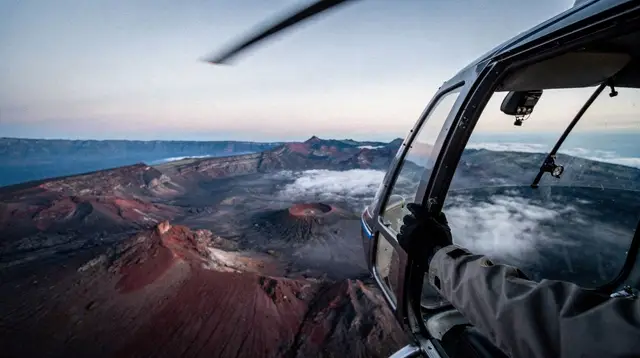
Haleakala Crater Helicopter Tour: What It Shows You
Is a helicopter tour a good way to see Haleakala crater?
Yes — a helicopter is the only way to see the full erosional valley at the summit of Haleakala from above, including sections invisible from any overlook or trail. Most Haleakala-focused flights depart from Kahului, combine the summit with the Hana rainforest coastline, and last 45 to 55 minutes; none require the sunrise reservation that a ground visit does.
What you actually see from the air
From the ground, Haleakala’s summit shows itself one overlook at a time: a rim, a parking lot, a short trail, a view that stops where the next ridge begins. From a helicopter, the whole shape of the mountain becomes readable in a single pass — the wide, eroded valley at Haleakala & Upcountry, the string of cinder cones along its floor, and the way the terrain drops from bare reddish rock at 3,055 meters down through cloud forest toward the coast in a matter of minutes.
That valley is the thing worth clearing up before booking. It looks like a crater and gets called one by habit, but it was not formed by an eruption. It is an erosional valley, carved by two rivers working from opposite sides of the mountain over a very long stretch of time, later dusted with cinder cones from smaller, more recent eruptions. Haleakala itself is dormant — it has not erupted in several centuries — not extinct, and there is no active lava anywhere on Maui. That belongs to the Big Island’s Kilauea, a different island entirely, reached by a short flight rather than a helicopter loop. A flight over Haleakala’s summit will not put you anywhere near flowing lava; it puts you above cinder, rock, and, depending on the hour, cloud.
How a Haleakala flight is usually built
Very few helicopter routes circle the summit on its own. Most combine it with the windward coast toward Hana, since the two lie along a similar flight path out of Kahului and the contrast between the bare summit and the green, waterfall-cut coastline is part of the appeal. A route built this way typically covers the crater floor, the cinder cones, and then drops toward the rainforest and coastal waterfalls near Hana & the Road to Hana before circling back.
a 45-minute flight pairing the Haleakala crater with the Hana rainforest coastline is the shape most travelers end up booking, precisely because it shows the summit and the coast in one trip rather than forcing a choice.
A close alternative runs a similar route without the exact same timing or aircraft:
a Hana rainforest helicopter route that also passes over Haleakala’s upper slopes — worth comparing on departure time and seat availability against the option above rather than assuming they’re interchangeable.
Neither of these is the general walkthrough of what a Maui helicopter flight involves start to finish — check-in, weight limits, headsets, what the aircraft looks like inside — which is covered separately in Maui Helicopter Tour: What to Expect. And neither is the west-side route over the Kaanapali mountains and sea cliffs, which is its own flight with its own scenery, detailed at West Maui Mountains Helicopter Tour: What This Route Actually Shows You. Booking the wrong one because the names sound similar is a common and avoidable disappointment.
Helicopter versus driving up: two different things, not competitors
It helps to be specific about what each option actually delivers, because they answer different questions rather than one replacing the other.
| Helicopter over Haleakala | Driving to the summit | |
|---|---|---|
| What you see | Full valley shape, cinder cones, coastline in the same trip | Rim-level view, sunrise or sunset light, the observatory area |
| Reservation needed | No | Yes, for sunrise entry (recreation.gov, 60 days ahead) |
| Time commitment | 45–55 minutes total | Half a day round trip from most bases |
| Cold exposure | Brief, in a heated cabin (unless doors-off) | Direct, near 0°C at dawn, with wind |
| Weather sensitivity | Cancels or reroutes around cloud | Can still visit even if cloud sits below the rim |
A ground visit for sunrise requires the recreation.gov reservation covering entries between 3 a.m. and 7 a.m., booked up to 60 days out, on top of the park entrance fee. That system exists because of literal foot and vehicle traffic at the rim at a specific hour — it has nothing to do with airspace, so flying over the summit sidesteps it entirely. The mechanics of that reservation, including the small next-day release, are covered at Haleakala Sunrise Reservation: How to Book It Step by Step, and the tradeoffs between joining a guided sunrise tour and driving yourself are laid out at Haleakala Sunrise: Guided Tour vs. Self-Drive.
If sunrise logistics feel like more than you want to manage but you’d still like ground time at the summit, a guided option removes the driving and the reservation headache:
a sunrise tour to the Haleakala summit that includes hotel pickup handles the early departure and the drive up in the dark, which is the part most people find hardest to plan around on their own.
Sunset at the summit, by contrast, does not require any reservation beyond the standard park entrance fee, and pairs reasonably well with a helicopter flight earlier the same day since the two show the mountain at different hours and from different vantage points:
a Haleakala sunset tour with snacks and photo stops included is worth considering for travelers who want ground time at the summit without an alarm before 3 a.m. More on how the sunset visit differs from sunrise is at Haleakala Sunset Tour: The Summit Without the Sunrise Reservation.
What the cabin feels like, and what it doesn’t need
Because the flight stays inside a heated cabin (unless a doors-off aircraft is specifically booked), the near-freezing temperatures and wind that make the ground summit visit genuinely cold are mostly not a factor here. Anyone planning the drive-up version instead should still take the cold seriously — the summit sits near 0°C at dawn year-round, covered in more detail at What to Wear at Haleakala Summit: Beating the Cold at 10,000 Feet — but a standard doors-on helicopter tour doesn’t call for the same layering.
Doors-off is a different aircraft configuration some operators run, generally for photography, and it does reintroduce cold air and wind at altitude. Whether that tradeoff is worth it depends on what you’re after and is broken down on its own at Doors Off vs Doors On: Choosing a Maui Helicopter Tour — it’s not a choice to make for the first time at check-in.
Weight, timing, and the honest limits of what you’ll see
Helicopter tours weigh passengers, not politely and not as an option — seating is assigned partly by body weight to balance the aircraft, and most operators publish a weight range or surcharge policy in advance. It’s worth checking a given operator’s policy before booking rather than after arriving at the counter.
Morning departures generally offer the clearest view of the crater floor, since Haleakala tends to build its own cloud cover as the day warms, most noticeably by early-to-mid afternoon. That’s a pattern, not a guarantee: cloud can sit over the summit at any hour, and no operator can promise a clear crater on a specific flight. If the valley is socked in on your booked morning, the coastal and waterfall sections of the route still deliver, but the defining view of the trip may be diminished. Flying early and keeping some flexibility in your Maui dates, where your itinerary allows it, is the only real hedge against this.
It’s also worth being clear-eyed about scale: from a cruising altitude with a wide-angle view, individual hikers on the crater’s Sliding Sands or Halemauu trails are rarely distinguishable, and the observatory domes near the summit are more of a landmark to orient by than a subject to photograph well. If you want an up-close, on-foot sense of that terrain, the Haleakala Crater Hiking Trails: A Guide to Walking the Summit guide covers the trails themselves, and the stargazing conditions near the summit’s observatories are detailed at Stargazing at Haleakala Summit: A Night Above the Clouds. Parking, entrance fees, and access logistics for a ground visit, sunrise or otherwise, are covered at Haleakala National Park: Parking, Access Road and Entry Fee Explained.
Combining the flight with a Hana Highway day
Because most Haleakala-inclusive helicopter routes also sweep along the coast toward Hana, some travelers use the flight as a preview or a substitute for parts of a full Hana Highway drive — particularly the sections that are hardest to see well from a car window, like waterfalls tucked into narrow valleys along the coast. That’s a reasonable way to think about it, but it’s worth being honest that the two experiences don’t overlap completely: the helicopter shows scale and shape from above in under an hour, while the drive itself, its stops, and its pace are their own full day. An overview of what that drive covers, mile by mile, is at Road to Hana Map: Every Stop in Order From Paia to Kipahulu if you’re deciding whether to do both.
For travelers weighing the whole island activities more broadly, the category page at Things to do at Haleakala and Upcountry rounds up ground-based Haleakala options alongside the flights, and Helicopter and air tours lists every helicopter route across the island, including the west Maui and Molokai-facing options that don’t touch Haleakala at all.
Booking timing and what changed after the sunrise reservation system began
The recreation.gov reservation requirement for sunrise entries reshaped how many visitors plan their Haleakala day, pushing some toward sunset visits or helicopter flights instead of competing for a limited number of early-morning slots. The background on how and why that system was introduced, and how it has evolved since, is covered in Why Haleakala Sunrise Now Requires a Reservation, which is useful context if you’re trying to decide whether to chase a sunrise reservation at all or build your Haleakala day around a flight and a daytime or sunset ground visit instead.
None of this changes booking mechanics for the helicopter itself: flights operate on the tour operator’s own schedule and seat availability, independent of the park’s reservation system, and can typically be booked with far less lead time than a sunrise slot — though morning departures on popular routes still sell out on busy weeks, particularly around whale season in winter when demand across all of Maui’s tours rises together.
Haleakala helicopter tours — the questions worth settling before booking
Do I still need the sunrise reservation if I see Haleakala by helicopter?
No. The recreation.gov sunrise reservation applies only to vehicles entering Haleakala National Park by road between 3 a.m. and 7 a.m. A helicopter flying over the summit is not entering the park by road, so it is unaffected by that system.
Will I see lava or an active volcano from the helicopter?
No. Haleakala is dormant, not extinct, and there is no active lava anywhere on Maui. What you see from the air is a reddish-brown erosional valley cut by two rivers over thousands of years, dotted with cinder cones — striking, but not volcanic activity in progress.
What time of day gives the best view of the crater from the air?
Morning flights, generally before mid-morning, tend to have the clearest air before clouds build up around the summit, which happens most afternoons. A clear crater floor is not guaranteed on any flight, since Haleakala makes its own weather.
Can I do a doors-off flight over Haleakala?
Some operators offer doors-off options on Haleakala and combination routes, though availability varies by aircraft and by day. Doors-off flights are colder at altitude and are covered in more detail in a separate comparison of doors-off versus doors-on flights.
How long is a typical Haleakala helicopter tour?
Most Haleakala-inclusive routes run 45 to 55 minutes, since they combine the summit with the Hana coastline and rainforest valleys rather than circling the crater alone. A handful of shorter west-side-only flights exist but skip Haleakala entirely.
Is the helicopter flight worth it if I already plan to drive up for sunrise?
The two show different things and are not redundant. Driving up puts you on the rim at ground level for sunrise light; flying over shows the valley’s full shape, the cinder cones, and the coastal waterfalls on the way to Hana that no overlook reaches.
Does bad weather cancel Haleakala helicopter tours often?
Cloud cover at the 3,055-meter summit is common, especially by afternoon, and operators reroute or reschedule rather than fly into it. Booking a morning slot and keeping flexible dates reduces the chance of a weather-related change.
Helicopter and air tours on GetYourGuide
Verified deep-linked GetYourGuide tours. Book through these links and we earn a small commission at no cost to you.
GetYourGuide does not provide a product photo for this activity — the image shows the meeting point, photographed by us.