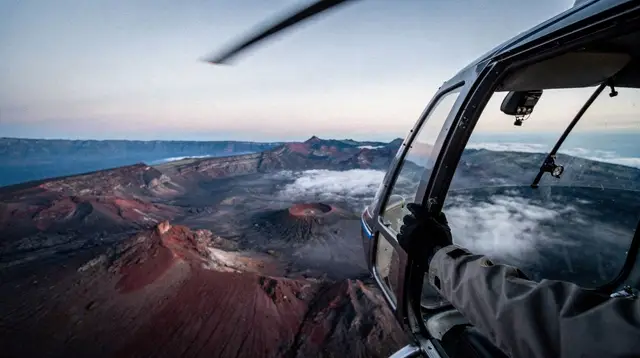
West Maui Mountains Helicopter Tour: What This Route Actually Shows You
What does a West Maui Mountains helicopter tour actually fly over?
It flies the steep, eroded ridges and valleys behind Lahaina and Kaanapali, past sea cliffs and waterfalls that have no public road access. It is a separate volcanic massif from Haleakala, extinct rather than dormant, and shows no active lava anywhere on the route.
A separate mountain range from Haleakala
Maui has two volcanoes, not one, and the West Maui Mountains route flies the older of the two. This massif built the western half of the island long before Haleakala rose on the eastern side, and it stopped erupting roughly 1.3 million years ago — long enough for wind and rain to carve it into the razor ridges, hanging valleys and near-vertical waterfalls you see from the air today. It is extinct, not dormant, and there is no active lava anywhere on this route or anywhere else on Maui. If a flight promises a volcano with visible heat or steam, that is a different island entirely, reached by its own interisland flight from Kahului.
For a comparison of what the two mountain routes actually show, see our overview of the Haleakala crater flight, which covers the younger summit crater near Kula rather than this coastal range. This page assumes you have already decided on West Maui and want to know what the route covers, not a general rundown of what any Maui helicopter flight involves — that ground is covered in our general guide to what to expect on a Maui helicopter tour.
What the route actually shows
Most West Maui Mountains flights depart from OGG in Kahului and head west across the isthmus before climbing over the range behind Lahaina and Kaanapali. From there, the standard flight path traces the interior valleys that have no public road: steep-walled canyons draining toward the coast, waterfalls that only run after rain, and knife-edge ridgelines separated by cloud-forest green so dense it looks almost black in shadow. This is the same interior terrain visible from the coast as a wall of green behind the resorts, but from the air you see the valleys running back into the mountain rather than just the front face.
The route typically continues north past the drier upper slopes near Kapalua and Honolua, then along the coastline toward Nakalele before turning back. Some operators extend the flight across the channel to Molokai’s north shore, which holds some of the tallest sea cliffs in the world and a set of waterfalls that drop directly into the ocean — a pairing that works because the two coastlines sit only a short hop apart. If that extension matters to you, confirm it is included before booking, since not every West Maui departure crosses the channel.
Why some of these waterfalls are helicopter-only
The interior of the West Maui range has no maintained trail network comparable to the Road to Hana side of the island. Several of its tallest waterfalls sit in valleys accessible only by a long, technical hike through private or conservation land, or not at all on foot. That is the practical case for this specific tour: it is not simply a scenic add-on, it is often the only way most visitors will see this particular set of falls, as distinct from Hana-area waterfalls that are reachable by a short walk from a parking area. If your priority is a waterfall you can actually stand next to and swim near, that is a different kind of day — see the Hana-side options in our Pipiwai Trail and Waimoku Falls guide or plan a full Road to Hana day instead of a flight over West Maui.
Weather on this specific route
The West Maui Mountains sit directly in the path of the northeast trade winds, and moist air rising against the peaks means the interior is often clouded in even when the coast at Kaanapali is clear and sunny. This is a real operational factor, not a minor caveat: a flight can be scenic at the coastline and then reroute around a socked-in ridge fifteen minutes later. Morning departures generally have the clearest visibility, before afternoon cloud buildup thickens over the summit ridge. Operators do not typically cancel for this — they adjust the flight path to stay under the ceiling and still show the accessible valleys — but it is worth knowing before you compare this tour to a Haleakala-side flight, where the upper slopes are drier and cloud cover behaves differently.
Wet season versus dry season on this route
Maui’s two seasons behave differently over the West Maui interior than they do at the beach. The wet season, roughly November through April, sends more rain against the windward-facing ridges, and the smaller seasonal waterfalls that barely trickle in summer can run full after a storm system passes through. The dry season, May through October, still shows the permanent falls fed by year-round streams, but the smaller cascades you sometimes see in tour photos may be reduced to a thin ribbon or absent entirely depending on recent rainfall. Neither season is objectively better for this flight — wet season means more dramatic waterfalls but a higher chance of the cloud rerouting described above; dry season means more reliable visibility but a quieter waterfall count.
Winter also happens to be humpback whale season in the Auau Channel between Maui, Lanai and Molokai, which the helicopter crosses briefly on routes extended toward Molokai. Whales are easier to spot from a boat at the surface than from a cruising altitude aircraft, so if seeing them is a priority, treat the helicopter and a whale watching boat tour as two separate activities on the same trip rather than expecting the flight itself to deliver whale sightings.
Comparing West Maui to other helicopter routes
| Route | What it covers | Typical length | Best suited to |
|---|---|---|---|
| West Maui Mountains | Interior valleys and waterfalls behind Lahaina and Kaanapali, sometimes extended to Molokai | 30–45 min | Waterfall and sea-cliff scenery, no-hike access |
| Haleakala crater | The dormant summit crater and upper slopes near Kula | 45–60 min | Volcanic terrain, crater rim views |
| Full island circle | Both mountain ranges plus the Hana coast in one longer flight | 60–90 min | First-time visitors who won’t fly twice |
If you are weighing doors-off against doors-on for whichever route you pick, that decision is covered separately in our doors-off versus doors-on comparison, since the tradeoffs (wind noise, temperature, unobstructed photos) apply the same way regardless of which mountain range you are flying over.
Booking this route
The most direct match for the West Maui route described above combines the mountain flight with a crossing to Molokai’s waterfalls and sea cliffs:
a helicopter flight over the West Maui Mountains that continues across the channel to Molokai’s waterfallsIf you’d rather see the same coastline from the water on a day when cloud cover makes flying less appealing, a boat trip along the same stretch of coast is a reasonable substitute for the views, if not the waterfalls themselves:
a boat tour along the West Maui coastline with breakfast and lunch includedFor travelers building a full day around Lahaina and the west side rather than a single flight, pairing the helicopter with a morning in the water is common. Two options that work well as a second activity on the same day:
a reef snorkeling trip at Olowalu, just south of Lahaina a surf lesson suited to any skill level, based out of the west sideNone of these substitute for the helicopter route itself — they are ways to fill the rest of a west-side day if the flight is booked for early morning and you have hours left afterward, or as a backup plan if weather pushes your flight to a later slot.
If you are visiting during the winter months and want to see the humpback whales that pass through the Auau Channel below the flight path, pairing the helicopter with a dedicated whale watching boat trip is the more reliable way to actually see one, since spotting a whale from cruising altitude is far less likely than spotting one from the water — see our guide to whale watching tours from Lahaina for options departing the same side of the island.
How this route fits into a west-side day or a wider itinerary
Because it departs from OGG rather than from Lahaina itself, this flight works most naturally as a standalone half-day activity rather than something you tack onto a Lahaina town visit at the last minute. Travelers building a broader look at west-side options sometimes compare this flight against a full West Maui day tour that covers the same coastline by road and boat instead of by air, or weigh Kaanapali against Wailea as a home base before deciding which airport drive makes more sense for an early departure.
For travelers still deciding between a self-guided west-side day and a more structured tour, our guided tour versus self-drive comparison covers the general tradeoffs — cost, flexibility, and how much of the day is spent driving versus doing — that apply whether you are choosing a helicopter, a boat, or a rental car for the same stretch of coast. And if this is one stop in a longer, multi-day west-side plan, several of our sample itineraries build a helicopter flight into a three-day first-timers itinerary or a seven-day complete itinerary alongside snorkeling and beach time on the same coast.
Practical notes specific to this route
Weight limits, seat assignment by weight, and the general boarding process are the same across all Maui helicopter operators and are covered in the general how-it-works guide linked above — this section only covers what differs for the West Maui route specifically.
Because the flight departs from Kahului and heads directly west, travelers staying in Kaanapali or Lahaina will have a longer drive to the airport than travelers based in Kihei or Wailea, roughly 45 minutes each way in typical traffic. Build that into your morning if you have booked an early departure to beat the afternoon clouds. There is no heliport in Lahaina itself; every commercial operator flying this route departs from OGG.
Because the West Maui interior is cloud-forest terrain rather than dry crater rock, expect more green in your photos and less of the reddish, volcanic-rim color palette associated with Haleakala flights. If you are choosing a route specifically for photography, that visual difference is worth weighing alongside the flight time and price.
West Maui Mountains helicopter tour: frequently asked questions
Is the West Maui Mountains helicopter tour the same as a Haleakala tour?
No. They cover two different volcanoes on opposite ends of the island. West Maui flights stay over the older, heavily eroded range behind Lahaina and Kaanapali; Haleakala flights cross the younger summit crater near Kula. Some longer itineraries combine both in one flight, but the standard West Maui route does not include the Haleakala summit.
Will I see lava on this tour?
No. The West Maui Mountains are extinct, not dormant, and have not erupted in roughly 1.3 million years. There is no active lava anywhere on Maui; the closest active flow is on the Big Island’s Kilauea, reached by a separate interisland flight.
Where do West Maui helicopter tours depart from?
Nearly all operators fly out of Kahului’s OGG airport on the island’s central isthmus, then head west toward the coast. A few smaller charter operations also use Kapalua airport, but OGG is the departure point for the large majority of bookings.
Can I see waterfalls on the West Maui route that I can’t reach by road?
Yes, that is the main appeal of this specific route. Several of the tallest falls in the range sit in valleys with no trail or road access at all, so a helicopter is the only practical way to see them, as opposed to the Road to Hana, where most falls are reachable on foot.
Does the West Maui tour ever combine with Molokai?
Some operators pair the West Maui Mountains with a short crossing to Molokai’s sea cliffs and waterfalls in a single longer flight, since the two coastlines sit close together across the channel. Check the specific tour description, since not every departure includes this extension.
Is this route affected by weather more than others?
The West Maui range sits directly in the path of trade wind clouds, so the interior ridgelines can be socked in even on a sunny beach day at Kaanapali. Morning flights generally have better visibility before afternoon cloud buildup, though operators reroute rather than cancel when conditions are marginal.
Do I need to book doors-off for this particular tour?
It is a matter of preference rather than a requirement of the route itself. The valleys and waterfalls photograph well through the windows on a doors-on aircraft, so this is not a tour where doors-off is necessary to see the terrain, unlike some photography-focused charters.
Is there a best time of year to fly the West Maui Mountains route?
The wetter months from roughly November to April tend to fill the interior waterfalls with more visible flow, since West Maui’s rainfall is heavier in that stretch. Winter also overlaps with humpback whale season in the Auau Channel below, so travelers who add a boat trip on the same visit often see whales from the water that they cannot see from the aircraft. The drier months from May to October still show the permanent falls and the sea cliffs, just with less runoff in the smaller seasonal ones.
How does the West Maui route compare on cost and time to a Haleakala flight?
West Maui flights tend to run shorter, in the 30 to 45 minute range, against 45 to 60 minutes for a Haleakala crossing, since the West Maui interior is a smaller area to cover from the same OGG departure point. A combined circle-island flight that shows both ranges plus the Hana coast takes longer still, in the 60 to 90 minute range. None of these figures are fixed prices; check the specific operator’s current listing before booking.
Helicopter and air tours on GetYourGuide
Verified deep-linked GetYourGuide tours. Book through these links and we earn a small commission at no cost to you.
GetYourGuide does not provide a product photo for this activity — the image shows the meeting point, photographed by us.