Honolua Bay Snorkeling: What Experienced Snorkelers Should Know
Is Honolua Bay good for snorkeling?
Yes, but only in calm summer conditions and for swimmers comfortable with a rocky, current-prone entry. It is a marine life conservation district with dense coral and reef fish, not a beginner beach like Kaanapali, and it closes to safe snorkeling whenever winter north swell reaches the bay.
A reef for snorkelers who have already done Kaanapali
If you have already snorkeled the reef off Kaanapali or worked through the best snorkeling beaches in Kaanapali and want something less crowded and more textured, Honolua Bay is the next step up the west coast, past Kapalua. It sits inside a state Marine Life Conservation District, which means no fishing, no anchoring, and a reef that has had decades to recover from extraction pressure. The coral cover is denser, the fish are less used to being fed, and on a calm day the water clarity along the point can exceed anything closer to town.
None of that makes it an easy beach. There is no sand, no lifeguard, and no facilities of any kind. The bay rewards someone who already knows how to read ocean conditions and is willing to turn around when they do not look right. This guide treats it that way: as a step up in difficulty, not a bigger version of the same afternoon at Lahaina.
Where it is and what you are looking at
Honolua Bay is on the northwest tip of West Maui, past the resort cluster of Kapalua, where the Honoapiilani Highway curves along cliffs above the water. The bay is a wide, horseshoe-shaped inlet backed by a dry gulch and ironwood trees, with a rocky point on its northern side that holds most of the healthy coral. There is no beach in the usual Maui sense — the shoreline is rounded volcanic boulders and a narrow cobble strip, which is the first thing that surprises visitors coming from the sand entries at Kaanapali or Kihei.
The bay also carries real history: it is a longtime big-wave surf break in winter, which is the same swell exposure that makes it unsafe for snorkeling that time of year. Locals watch this coastline closely, and the etiquette here — quiet voices, no loud groups, no gear left on the rocks — matters more than at a resort beach.
Marine Life Conservation District rules
Honolua Bay’s protected status is not a formality. As a state Marine Life Conservation District, it is illegal to fish, collect shells or coral, or feed any fish in the bay, and anchoring is prohibited for the same reason the reef has recovered as well as it has. Standing on coral, even briefly to steady yourself in surge, damages structure that took decades to grow back — if you need to stop and reset, look for open sand or bare rock instead of the nearest coral head. The rule set is the same one that protects reefs across the island’s snorkeling and diving sites, but it is enforced more visibly here because rangers and longtime residents treat the bay as a point of local pride.
None of this changes what you are allowed to do in the water — swim, look, photograph — only what you touch or take. Divers exploring more of the coast under these same protections may also want the broader scuba diving tours in Maui guide for sites with similar reef-etiquette expectations.
Getting there and parking
From Lahaina, it is roughly a 25 to 30 minute drive north on the Honoapiilani Highway, past Kaanapali, Napili, and Kapalua. The access point is a marked pullout on the highway, on the gulch side, with an unpaved trail dropping down through trees to the rocky shore — about a five-minute walk each way, uneven underfoot, with roots and loose rock.
Parking is roadside shoulder space, not a lot, and it fills early on calm summer mornings. There is no fee, but there is also no overflow lot, so arriving after mid-morning on a clear day often means circling or giving up. If you are staying in Kihei or Wailea, factor the crossing time through Kahului or over the pali into your morning — this is not a spot you reach on a whim between other plans. Anyone deciding whether they need a rental car in Maui should know Honolua Bay is one of the clearest arguments for one: no bus route reaches it.
Timing the drive matters as much as timing the swell. Winds on this coast typically build through the morning, which is why the calmest water and the easiest parking both cluster before roughly 9 or 10 a.m. Arriving right after sunrise means a near-empty pullout and glassy conditions along the point; arriving at midday on a clear summer day usually means parking well down the highway shoulder and walking further than the short official path. If your stay is based on the south side, cross-referencing the Maui weather by month guide before you commit an entire morning to the drive is worth the five minutes it takes.
Entering the water: not a wade-in beach
The entry is the main technical difference from Kaanapali or Kapalua Bay. There is no gently sloping sand — you step from rounded, sometimes slick boulders directly into water that can have a light surge even on a calm day. Reef shoes or sturdy water sandals make a real difference here; bare feet on wet volcanic rock is how most minor injuries at Honolua happen.
Most snorkelers enter on the right (south) side of the bay, where the rock shelf is a little more even, then swim out and along toward the point. The healthiest coral and the most fish activity are concentrated near the point itself, which also tends to have the strongest current — a detail regularly left out of casual write-ups. Stay aware of your position relative to the rocks and the open water beyond the point; there is no boat or lifeguard nearby to help if you drift past it. Snorkelers who prefer a monitored, guided version of a reef this rich, without managing the entry themselves, do better on a boat trip to a reef like Olowalu.
a guided boat snorkel over the coral gardens at Olowalu, a calmer alternative reef on the same coast covers similar reef density with an easier, sand-adjacent entry and a crew watching conditions, which is worth considering if Honolua’s surge on a given day looks stronger than expected.
Conditions: when it works and when it does not
Honolua Bay is a seasonal proposition. The same north-facing exposure that turns it into a respected winter surf break makes it unsafe for snorkeling for a large part of the year.
| Season | Typical conditions | Snorkeling verdict |
|---|---|---|
| May – September | Calm, glassy mornings common | Best window; go early |
| October | Transitional, swell picks up | Check conditions daily |
| November – March | North/northwest swell, surf breaking | Usually unsafe; often a surf spot instead |
| April | Transitional, improving | Check conditions daily |
There is no gate and no official closure notice — the bay simply becomes unswimmable when swell arrives, with whitewater breaking across the mouth of the inlet. If you see surfers out, that is your answer for the day. This is different from a spot like Molokini, where a boat operator makes the call for you; here, the judgment is yours. Anyone timing a Maui trip around the best month to visit for snorkeling should treat Honolua as a summer-only stop, not a year-round guarantee, and cross-check the monthly weather guide before building a full day around it.
What you will actually see
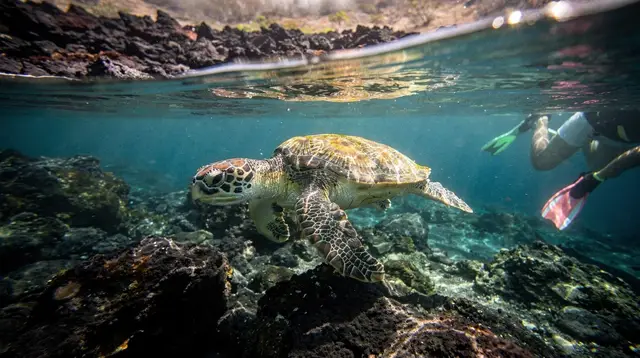
On a calm day, the coral structure along the point is the draw: large plate and finger coral formations, healthy branching coral in the shallows, and noticeably more fish biomass than at more heavily visited reefs closer to the resorts. Expect parrotfish, unicornfish, butterflyfish, and frequent green sea turtles resting or grazing near the rocky points.
The turtle rule applies here exactly as it does everywhere in Hawaii: federal law requires staying at least 3 meters (about 10 feet) away, with no touching, blocking, or chasing, and no approaching a turtle resting on rock. Turtles at Honolua are used to some distance from people, and closing that gap is both illegal and the fastest way to spook the animal you came to see. If turtle encounters are the priority rather than reef structure, Turtle Town off Makena and the broader guide to where sea turtles are seen around Maui are more consistent, sheltered options on the south side of the island.
Visibility is typically excellent in summer — often 60 feet or more on a clear, calm morning — which is part of why experienced snorkelers rate this bay above the more sheltered coves nearby.
Safety without a lifeguard
There is no lifeguard tower at Honolua Bay and no regular patrol, which is the single biggest difference from a resort beach like Kaanapali. That makes a few habits worth treating as non-negotiable rather than optional: snorkel with a buddy who can go for help, stay inside your own comfort zone with distance from shore, and turn back the moment surge or current feels stronger than it looked from the pullout above. Cell coverage along this stretch of the Honoapiilani Highway is generally usable, so calling 911 in a real emergency is possible, but help still has to drive the same winding highway to reach the bay — there is no fast response the way there is at a monitored beach.
Checking conditions before you leave your accommodation is the cheapest safety step available. A flat, glassy morning reported for Kaanapali or Lahaina does not guarantee the same at Honolua, since the bay faces a different direction and reacts to north swell that the leeward resort beaches never feel. If the ocean looks confused, has whitewater at the point, or has noticeably more people standing on the rocks watching than swimming, treat that as your answer and save the bay for another morning.
Honolua Bay compared to easier west-side options
| Spot | Entry | Best for | Facilities |
|---|---|---|---|
| Honolua Bay | Rocky, some surge | Confident swimmers, reef and fish variety | None |
| Kapalua Bay | Sand, sheltered | Families, first-time snorkelers | Restrooms, showers |
| Napili Bay | Sand, gentle | Beginners, sunset swims | Limited |
| Black Rock, Kaanapali | Sand then rock ledge | Easy access, turtles near shore | Full resort amenities |
If you are traveling with a mixed-experience group and Honolua looks too exposed on the day you visit, Kapalua Bay is a five-minute drive south and a far gentler substitute — worth comparing against the fuller rundown in the Kaanapali versus Wailea guide and the broader West Maui versus South Maui comparison if you are still deciding where to base your stay. Families snorkeling with children are usually better served by the options in the family-friendly snorkel tours guide than by Honolua’s rocky entry.
a guided sea-scooter snorkel at nearby Kapalua Bay, a sheltered sand-entry alternative is a reasonable fallback for the same morning if the bay itself is showing surge or reduced visibility when you arrive — check it before committing to the rockier walk down to Honolua.
What to bring and what to skip
Bring your own mask, snorkel, and fins if you have them; there is no rental kiosk at the bay itself, and the closest options are back toward Kapalua or Lahaina — see the separate snorkeling gear rental guide if you need to arrange this before you drive out. Reef shoes are close to essential given the rock entry. Bring drinking water, as there is nothing on site, and pack out everything you bring in.
On sunscreen: Maui County bans the sale, distribution, and use of sunscreens containing oxybenzone, octinoxate, or octocrylene, in effect since October 2022. A mineral, zinc-based sunscreen is the only compliant option, and there is nowhere at Honolua to buy one if you forget it — pack it before you leave your accommodation.
Who should skip it, and what to do instead
Honolua Bay is not the right call for young children, hesitant swimmers, anyone snorkeling for the first time, or a group visiting between November and March. In those cases, the sand-entry bays at Kapalua and Napili, or Kaanapali’s Black Rock, deliver a comparable west-side experience with far less risk. A guided boat trip removes the entry problem entirely and adds a crew watching the water for you.
a guided snorkel outing along the Lahaina coastline aimed at less experienced or nervous swimmers is a lower-pressure way to see reef and fish life without managing rocks, current, or entry timing yourself. For anyone still building basic water confidence before any of this, small-group swim lessons based in Lahaina is a sensible step to take before attempting an open, unmonitored bay like Honolua.
If your trip window falls in winter, the bay’s north-facing exposure that keeps snorkelers out is the same swell that makes December through March prime time to watch for humpback whales passing this same stretch of coast — see the dedicated whale watching season guide for timing, since a calm-looking day in winter can still turn out to be a whale-watching morning rather than a snorkeling one.
Planning the rest of the day around it
Because Honolua Bay is a short visit rather than a half-day activity, most people pair it with other stops along the same stretch of coast: breakfast in Kapalua, a walk through Lahaina on the way back, or an afternoon at one of the sand beaches covered in the Kaanapali snorkeling guide. If you are still working out how many days you need in Maui or when to visit overall, treat Honolua as a bonus stop for a clear-weather morning rather than the anchor of your itinerary — its value depends entirely on conditions you cannot control from home.
For a full sense of what else the things to do in Lahaina area and the wider snorkeling and diving category cover, both are worth browsing before you lock in a single day plan around one unpredictable bay.
Snorkeling and diving on GetYourGuide
Verified deep-linked GetYourGuide tours. Book through these links and we earn a small commission at no cost to you.
GetYourGuide does not provide a product photo for this activity — the image shows the meeting point, photographed by us.