Best Month to Visit Maui for Snorkeling
What is the best month to visit Maui for snorkeling?
Late spring through early fall (May to October) is Maui's dry season, generally calmer for snorkeling around the island. Winter (December to April) brings more wind and swell on some coasts but overlaps with humpback whale season, which many snorkelers actually want to combine with their trip.
Choosing a snorkeling season, not a single perfect date
Anyone building a Maui trip around snorkeling eventually asks the same question: when should I go? The honest answer is that Maui does not have four seasons, it has two, and neither one is simply “good” or “bad” for snorkeling. What changes between them is general sea conditions on different coasts, and whether humpback whales are in the water at the same time you are. Those are two separate questions, and this guide keeps them separate rather than folding them into a single verdict.
This page will not invent a water temperature or a visibility number for any given month — nothing here is measured to that level of detail, and a guide that states “22°C in March” or “30-foot visibility in July” without a source is guessing. What follows instead is the general pattern: which part of the year tends to be calmer, which part overlaps with whale season, and how to weigh the two against each other depending on what you actually want from your snorkeling days.
For the island’s overall weather patterns month by month, see Maui weather by month. For whale season on its own terms, see whale season in Maui: when to go. This page sits between the two, specifically for people planning their trip around snorkeling.
The two-season pattern behind the decision
Maui runs on a dry season and a wet season, not four seasons. The dry season runs roughly from May to October; the wetter season runs roughly from November to April. That split matters for snorkeling less because of rain and more because of the swell and wind patterns that come with it.
In general terms, the calmer season on more of the island’s coastline lines up with the dry months. The more variable season, with larger swell reaching some shores, lines up with the wetter months. This is a broad pattern across the island, not a site-by-site forecast — Maui has coasts that face in different directions, and a swell that closes one beach can leave another completely unaffected.
| Period | General pattern | What else is happening |
|---|---|---|
| Roughly May–October | Calmer season on more coasts | Central Pacific hurricane season (June 1–Nov 30) |
| Roughly November–April | More variable, wind- and swell-dependent | Humpback whale season (peaks January–March) |
Because whale season sits entirely inside the more variable half of the year, the two things a snorkeling-focused traveler cares about — calm water and whale encounters — pull in different directions. That tension is the real subject of this guide.
If calm water is your priority
If the goal is the most straightforward, least weather-dependent snorkeling trip, the dry season from roughly May through October is the safer general bet. More of the island’s coastline tends to be workable, shore snorkeling is less likely to be scrapped by swell, and boat operators have fewer days where a site gets swapped for a calmer alternative.
This does not mean every day in July is flat calm and every day in January is rough. Wind still varies day to day, and some south-facing and leeward sites can snorkel well even in the wetter months. What it means is that, taken across the whole season, the dry months carry less risk of a plan falling through.
For sites that are especially exposed to seasonal swell, this distinction matters more than average. Honolua Bay, for instance, is known to snorkel very differently depending on whether winter swell is running — check that guide before building a day around it specifically. Boat-based sites reached across more protected water, including the crossing to Molokini, are generally less exposed to this seasonal swing, though they are still subject to daily wind.
Hurricane season runs June 1 through November 30 in the central Pacific, overlapping the calm season. A direct hit on Maui is uncommon, but it is worth knowing this window exists if you are booking boat-dependent snorkeling far in advance; a distant storm can occasionally push in swell or cause a same-day cancellation even without making landfall.
If you want whales and snorkeling on the same trip
Humpback whales are in Maui’s waters roughly from December through April, with the largest numbers typically seen from January through March, in the Auau Channel between Maui, Lanai, and Molokai. That entire window falls inside the wetter, more variable half of the year — there is no way to get guaranteed whale season and guaranteed calm-season snorkeling conditions at the same time, because the two windows don’t overlap.
That trade-off is worth being explicit about rather than glossing over. A trip in February gives you a real chance at whale sightings that simply do not exist in July, but it also means accepting a higher chance of a rough day, a rescheduled boat, or a site that isn’t snorkeling as well as it might in June.
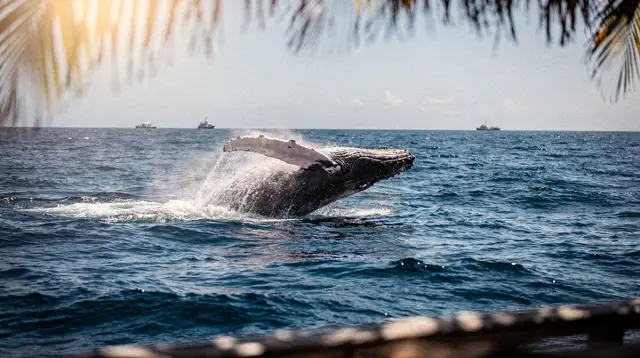
In practice, most snorkel boats do not swim guests with whales — approaching whales in the water is regulated, and operators keep a minimum distance by law. What often happens instead is that a boat heading out to a snorkel site in whale season passes whales en route, or a captain points out a distant blow or breach. It’s a bonus layered on top of the snorkeling, not a replacement for it. For anyone whose main goal is whale watching rather than snorkeling, a dedicated boat such as those covered in whale watching tour from Lahaina is a more direct way to do that, and the whale season guide covers timing for whale watching on its own terms.
If you’re weighing this trade-off, it helps to ask which outcome you’d be more disappointed to miss. Someone who has never seen a humpback whale and may not get another chance for years will often accept a somewhat rougher sea for a January or February trip. Someone whose whole trip is built around a single big snorkeling day, such as a Molokini crossing, may prefer the better seasonal odds of a spring or fall booking.
Shoulder months worth considering
Rather than picking an extreme end of either season, some of the more balanced months sit at the edges of the calm season: April, May, September, and October. April can still catch the tail end of whale season while conditions are trending calmer; May and September sit inside the dry season with generally lower visitor numbers than the July–August peak; October is late enough in the dry season to usually still be settled, and early enough that hurricane season risk is winding down.
None of these are guaranteed sweet spots — they are simply the months where the two seasonal patterns overlap least awkwardly. If your trip dates are flexible and snorkeling is the priority, these shoulder months are a reasonable place to start looking rather than anchoring hard to either “peak whale season” or “peak dry season.”
What the season does not decide for you
Two things matter as much as the time of year, and neither is really a “season” question.
The first is which site you’re snorkeling on any given day. Maui’s coasts face different directions, so a swell pattern that ruins conditions on one shore can leave another completely unaffected. This guide deliberately stays general — for site-specific detail, see guides such as best snorkeling beaches in Kaanapali, Molokini snorkel tour from Maalaea, Molokini snorkel tour from Wailea, and Turtle Town snorkel tour from Makena.
The second is what time of day you go out, which is a separate question from what month you go. Wind on Maui typically builds through the morning and afternoon regardless of season, which is why boats leave early. That’s covered in detail in best time of day for a Molokini snorkel and morning versus afternoon Molokini snorkeling — don’t confuse “best month” with “best hour,” they’re answered by different pages for a reason.
For getting geared up regardless of when you go, snorkeling gear rental in Maui and what to bring for a Molokini snorkel cover the practical side. If a deeper dive into the crater interests you beyond snorkeling from the surface, Molokini crater: the back side and scuba diving tours in Maui go further.
Booking a snorkeling trip around your chosen window
Once you’ve settled on a general window, a guided boat trip removes most of the remaining guesswork: operators track daily conditions and choose the site that’s working that morning, which matters more day to day than the month on the calendar. A standard outing such as a guided snorkeling tour with gear and instruction included is a straightforward way to get in the water without owning or renting your own equipment.
For a trip centered on the island’s best-known site, a Molokini snorkeling trip departing from South Maui crosses to the crescent’s protected water, which tends to be less exposed to seasonal shore swell than some coastal sites. Those who want the day extended into sailing and a meal can look at a snorkeling and sailing trip with a buffet lunch included, or, departing from the west side, a West Maui sailboat tour combining snorkeling with meals on board.
None of these trips are described here as available at every hour or every day of the year; boat operators adjust routes and sometimes cancel outright when conditions call for it, which is one more reason the general season matters less than the specific forecast on your travel dates. Building in a spare day or two, especially if you’re traveling in the wetter months, gives a rescheduled trip somewhere to land.
Planning your wider trip around this window
Snorkeling season is one input into a much larger set of trip-planning decisions — when to fly in, how many days to spend, and what else to build around your snorkeling days. For the broader question of timing a Maui trip overall, best time to visit Maui looks at more than just the water. For sea life questions beyond whales, guides on turtles and other sightings sit alongside the site-specific pages linked above.
Frequently asked questions about timing Maui snorkeling trips
Is summer or winter better for snorkeling in Maui?
Summer, in the sense of the dry season running roughly May to October, tends to bring calmer, more settled conditions to more of the island’s coastline. Winter can be rougher, especially on north-facing shores, but it is also whale season, which changes the calculation for many visitors.
Can I see whales while snorkeling in Maui?
Snorkel boats do not target whale encounters in the water, since approaching whales while swimming is regulated. But during whale season, boats heading to snorkel sites often pass whales en route, and captains slow down or point them out. For a trip built around whales specifically, see our dedicated whale season guide.
Does the time of year affect which snorkel sites are open?
Some shore sites, particularly on exposed north- or west-facing coasts, become impractical when winter swell rolls in, while they snorkel well in calmer months. Boat-based sites reached by protected-water crossings are less affected by the season and more affected by daily wind timing.
Is there a single best month, or a best window?
There is no one perfect month documented for Maui as a whole. The general pattern is a calmer season from around May to October and a more variable, wind- and swell-dependent season from November to April, with whale season sitting inside that second window.
Should I plan my snorkeling around the morning or around the season?
Both matter, but they answer different questions. The month affects general sea conditions and whether whales are around; the time of day affects wind and boat traffic on any given morning. See our guide on the best time of day for a Molokini snorkel for the daily side of this.
Does hurricane season affect snorkeling in Maui?
The central Pacific hurricane season runs from June 1 to November 30, overlapping with the calmer dry season described above. A direct hit is uncommon, but distant storms can occasionally push in swell or cancel boat trips for a day or two; this is a scheduling risk to be aware of, not a reason to avoid summer.
Will I definitely see turtles or clear water if I pick the “right” month?
No. Turtle sightings, water clarity, and general conditions vary day to day and site to site, and nothing here is a guarantee. Choosing a calmer season improves the odds of an easy, comfortable outing; it does not promise a specific result.
Seasonal Maui activities on GetYourGuide
Verified deep-linked GetYourGuide tours. Book through these links and we earn a small commission at no cost to you.
GetYourGuide does not provide a product photo for this activity — the image shows the meeting point, photographed by us.