Scuba Diving Tours in Maui: Sites, Certification, and What to Book
Do you need to be certified to scuba dive in Maui?
No. A Discover Scuba Diving session lets an uncertified traveler dive under close supervision to about 12 meters, no certification required. Going deeper, doing a second dive without an instructor at your side, or diving from a boat on a two-tank trip requires an Open Water certification, which most Maui shops will not skip.
Certified diver or first-timer: two different trips
Maui’s ocean is a snorkeling destination first and a diving destination second, and the two activities get lumped together more often than they should. Snorkeling asks nothing of you beyond a mask and the ability to float; scuba diving asks for either a certification card or an instructor holding your hand the entire descent. If you already dive, Maui rewards the extra planning with a wall dive most snorkelers never see. If you have never dived, the island is also a reasonable place to try it for the first time, under supervision, before deciding whether to spend a weekend getting certified back home.
This page is written for both of those readers, and for neither is it a plan for snorkeling at the surface or a manta ray snorkel, both covered elsewhere on the site. If gear rental for surface snorkeling is what you actually need, that lives at snorkeling gear rental instead.
Certification levels, and what each one lets you do
Three tiers cover almost everyone who dives on a Maui vacation:
| Level | Who it’s for | Typical depth limit | Supervision |
|---|---|---|---|
| Discover Scuba Diving | No certification, trying it once | About 12 m | Instructor in the water at all times, 1:2 ratio or tighter |
| Open Water certified | Holds a card from any recognized agency | 18 m (dive-shop policy, often less on a first local dive) | Buddy diving, guide present on boat trips |
| Advanced Open Water / deep specialty | Certified with logged depth experience | 30 m or the site’s practical limit | Buddy diving, less oversight |
A Discover Scuba session is not a shortcut to real certification. It is a single supervised dive, sold as an experience rather than a qualification, and it will not get you onto a standard two-tank boat trip built for certified divers. If trying scuba on this trip convinces you it is worth pursuing, the actual multi-day certification course is a separate booking, usually done in the pool and classroom first, and it is a bigger time commitment than most one-week vacations can absorb alongside everything else on a Maui itinerary.
If you are certified already, bring your card and logbook. Shops will ask, and a diver who has not been in the water in a year or two may be offered a supervised refresher dive before being cleared for anything deeper or more current-exposed.
Where the boats go
an underwater submarine tour is worth mentioning here precisely because it is not scuba diving: it is the option for someone who wants to see Maui’s reef life from below the surface without gear, certification, or getting wet at all, and it is a fair way to preview what the reef looks like before committing to a dive trip.
For actual diving, two harbors handle nearly all of it. Maalaea Harbor sits closest to Molokini, the crescent-shaped islet 4 kilometers off the south shore, which makes it the usual departure point for morning dive trips heading there. Lahaina Harbor in west Maui runs its own mix of boat dives, generally along the west side reefs and toward Turtle Town and other sites off Makena and south Maui.
Molokini itself has two very different faces underwater. The inside of the crescent is shallow, protected, and shared with snorkel boats — that side is covered in Molokini’s back-wall snorkeling guide. The outside, or back wall, is the dive site: a near-vertical drop that starts around 10 meters and continues well beyond recreational limits, with visibility that regularly exceeds 30 meters on a calm morning. Currents on the back wall can be strong and unpredictable, which is why most operators restrict it to certified divers and read conditions boat-by-boat rather than promising it on every departure.
Shore diving, for certified divers without a boat budget
Not every dive on Maui requires a boat. Mala Wharf, near Lahaina, is the island’s best-known shore dive: a collapsed pier, damaged by a hurricane decades ago, whose broken pilings now function as an artificial reef thick with fish life. It is shallow enough for a relaxed dive, entry is from a small parking area, and several shops in west Maui will guide it or simply fill tanks for divers doing it independently.
In south Maui, the reef fronting Ulua and Mokapu beaches in Wailea offers another accessible shore entry, closer to the resorts than to any harbor. Shore diving costs less than a boat trip because there is no vessel to run, but conditions are more exposed to surface chop and current than a sheltered boat site, and a shop briefing beforehand is worth having even for an experienced diver unfamiliar with the entry.
What a two-tank boat trip actually looks like
A standard certified-diver trip out of Maalaea or Lahaina runs two tanks over a morning, typically four to five hours door to door once you count gear setup, the ride out, two dives with a surface interval between them, and the ride back. Expect to pay roughly 150 to 220 US dollars before the county’s general excise tax, with full gear rental (BCD, regulator, wetsuit, weights) usually included in that price rather than billed separately — worth confirming before you book, since a few operators itemize gear as an add-on.
Morning departures are standard, and not just for convenience: wind and chop build through the day across the Auau Channel and the waters around Molokini, the same pattern that pushes snorkel-boat operators toward early trips. A dive boat fighting afternoon swell is a worse dive and a rougher ride, so book the earliest slot a shop offers if the schedule allows it.
Discover Scuba sessions run shorter and shallower, often as a single dive bolted onto a snorkel-boat itinerary or run as a standalone half-day. If you are choosing between trying scuba for the first time and simply doing a well-guided snorkel, a guided snorkeling tour with gear and instruction is a lower-commitment way to spend a morning in the water and decide, cheaply, whether the ocean side of the vacation is where you want to spend more of your budget.
Medical questions and the fine print
Every dive shop will hand over a medical questionnaire before a Discover Scuba session or a first dive of the trip, covering conditions like asthma, heart problems, recent surgery, and pregnancy. Answering yes to certain questions means a physician’s sign-off is required before diving, and that paperwork does not happen same-day, so anyone with a relevant condition should sort it out before flying to Maui, not at the dive shop counter.
Two timing rules matter more on this island than most:
- No diving within 18 to 24 hours before flying or gaining significant altitude. Maui’s own summit at Haleakala sits at 3,055 meters. A dive in the morning followed by a sunrise or sunset trip to the summit the same day, or even the next morning, puts a diver at risk of decompression sickness. Schedule diving and the summit on separate days with a full day between them if possible.
- No diving right before an inter-island or mainland flight. The same altitude rule applies to the cabin pressure of any flight leaving OGG, so plan diving for early in your stay, not your last morning before departure.
Alcohol and diving do not mix, and shops will not put a hungover guest in the water for good reason beyond liability — narcosis risk increases, and judgment underwater is not something to gamble on the morning after a sunset cruise got a little long.
Turtles, and the same distance rule that applies everywhere
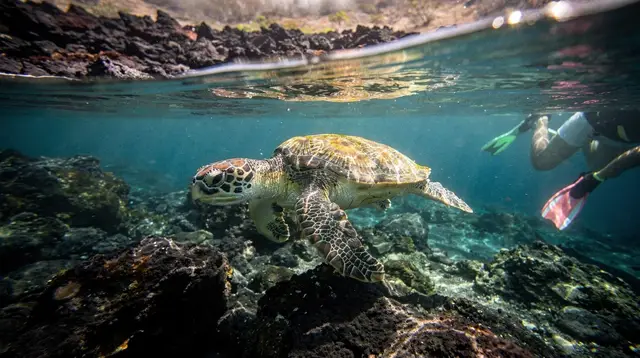
Green sea turtles show up on dive sites as reliably as they show up on snorkel trips, and the same federal rule applies regardless of what is on your back: a minimum of 3 meters, no touching, no chasing, and extra distance if a turtle is resting on the bottom rather than swimming. A diver’s better buoyancy control makes it easier to actually hold that distance than it is for a snorkeler kicking at the surface, which is one more argument, if you already dive, for choosing a dive over a snorkel when turtles are the goal. For a rundown of where turtles show up most reliably around the island, this guide to Maui’s turtle spots covers both the snorkel and shore-access sites.
Whales, visibility, and when to go
December through April brings humpback whales into the Auau Channel between Maui, Lanai and Molokai, and while whales are not something a scuba trip is built around — federal approach rules keep boats and swimmers well clear of them — winter boat rides to dive sites often include whale sightings on the surface transit, purely as a byproduct of being on the water at the right time of year.
Visibility, by contrast, runs in the opposite seasonal direction from what many visitors expect: it holds up reasonably well year-round at Molokini specifically, because the site sits offshore away from runoff, but coastal shore-dive visibility around the rest of the island tends to drop after heavy rain, which is more common November through April than in the dry summer months. A shore dive planned for the day after a big rain is worth rescheduling if visibility matters to you.
Booking logistics and getting to the harbor
Neither Maalaea nor Lahaina Harbor sits on a Maui Bus route useful for an early departure, so a rental car or a pre-arranged shuttle is the practical way to make a 6:30 or 7:00 a.m. check-in. If you are staying in west Maui and diving out of Maalaea, or the reverse, build in real drive time — the Honoapiilani Highway between the two coasts is not a quick hop, especially before the harbor traffic and school-run traffic of a weekday morning.
Shops generally ask certified divers to check in 30 to 45 minutes before departure to sort gear and sizing, longer for anyone renting a full wetsuit and BCD setup. Bring your certification card and logbook, a hat and reef-safe sunscreen for the surface intervals, and layers for the ride back — the boat wind chills faster than the water itself. Reef-safe here is not optional: Maui County bans the sale, distribution, and use of sunscreens containing oxybenzone, octinoxate, or octocrylene, so pack a mineral, zinc-based sunscreen before you leave home rather than counting on finding one at the harbor.
If your Maui days are split between a first dive attempt and everything else on the list, pairing it with a broader look at the coast makes sense logistically: a west side highlight tour covers the coastline your dive boat only glimpses from the water, and a stop at the Maui Ocean Center in Maalaea, right by the harbor, is a useful way to identify reef fish and coral before or after you see them for real underwater.
Scuba diving in Maui: the questions that come up most
Do I need to be a certified diver to try scuba diving in Maui?
No. Dive shops run Discover Scuba Diving sessions for uncertified guests, with an instructor in the water the entire time and a depth limit around 12 meters. Anyone wanting to dive independently, go past that depth, or join a standard two-tank boat trip needs an Open Water certification card.
Where do scuba boats leave from in Maui?
Most operators leave from Maalaea Harbor or Lahaina Harbor. Maalaea sits closest to Molokini and its back wall, which is why early Molokini dive trips tend to depart from there rather than from the west side.
Can I scuba dive at Molokini?
Yes, and the crater’s outer back wall is Maui’s best-known dive site, a near-vertical drop that starts around 10 meters and continues well past sport-diving limits. It is a boat dive, and most operators reserve the back wall for certified divers because of depth and current.
Is shore diving possible on Maui, or do I need a boat?
Both exist. Certified divers can shore dive at sites such as Mala Wharf near Lahaina or the reef in front of Ulua Beach in Wailea, usually with a shop that supplies tanks and a guide. Boat dives reach sites shore access cannot, including Molokini and deeper offshore reefs.
How much does a scuba trip cost in Maui?
A two-tank boat dive for certified divers typically runs in the 150 to 220 US dollar range before tax, gear rental included. A Discover Scuba introductory dive for a non-certified guest runs somewhat less. Full certification courses, run over two to three days, cost more and are less common to book as a single vacation activity.
Can I scuba dive and then fly to Haleakala’s summit the same day?
No. Standard diving guidelines call for at least 18 to 24 hours between a dive and any significant altitude gain. The Haleakala summit sits at 3,055 meters, well above that threshold, so a dive day and a sunrise or stargazing trip to the summit should not be scheduled back to back.
What is the difference between a scuba tour and a snorkeling tour in Maui?
Snorkeling stays at the surface with a mask, snorkel and fins, open to nearly anyone who can swim. Scuba diving uses a tank and regulator to breathe underwater, requires either an instructor’s direct supervision or a certification card, and reaches depths and sites, like the Molokini back wall, that snorkelers never see.
Snorkeling and diving on GetYourGuide
Verified deep-linked GetYourGuide tours. Book through these links and we earn a small commission at no cost to you.
GetYourGuide does not provide a product photo for this activity — the image shows the meeting point, photographed by us.