Best Snorkeling Beaches in Kaanapali
Where is the best shore snorkeling in Kaanapali?
Black Rock (Puu Kekaa), at the north end of Kaanapali Beach in front of the Sheraton, has the clearest water and the most fish and turtles you can reach on foot. Napili Bay and Kapalua Bay, a short drive north, are calmer and better for families or nervous swimmers.
Snorkeling straight off the sand in Kaanapali
If you are staying in Kaanapali and want to snorkel without arranging a boat, you have real options within walking or short driving distance of most hotels. This is not a guide to Honolua Bay, which sits closer to Lahaina and deserves its own trip, and it is not about scuba diving or the night manta ray snorkel, both of which involve gear or timing you would book separately. This is about what a family or a couple can do with a mask, fins and a rental car (or none at all) on an ordinary beach day.
The short version: Kaanapali Beach itself is a 5-kilometer stretch of sand, and it is not uniformly good for snorkeling. Most of it is open sandy bottom with little to see. The exception, and the reason people come here specifically to snorkel, is Black Rock at the north end. A little further north, outside Kaanapali proper but easily reached by car, Napili Bay and Kapalua Bay add two calmer, smaller options.
Black Rock (Puu Kekaa): the main event
Black Rock is a lava outcrop at the northern tip of Kaanapali Beach, in front of the Sheraton Maui Resort. It is the single best piece of shore snorkeling in west Maui that requires no boat, no reservation and no fee beyond parking.
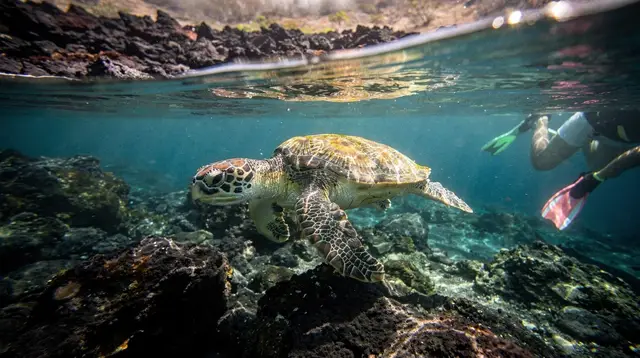
What makes it work is simple: the rock itself is a hard structure jutting into deeper water, so it draws fish and turtles that the flat sandy stretches of Kaanapali don’t. Expect parrotfish, needlefish, various butterflyfish, occasional green sea turtles feeding on the algae along the rock’s base, and, if you are lucky and out early, an octopus tucked into a crevice.
A few practical points:
- Entry is easiest from the beach just south of the rock, in front of the Sheraton. Wade in over sand, then swim toward the rock’s base once you’re past the shallow shorebreak.
- Best time is early morning, generally before 10 a.m., both for calmer water and for beating the crowds. By midday, the same spot fills with swimmers, paddleboarders and cliff jumpers using the rock’s ledge, and visibility drops as more people stir the sandy bottom near shore.
- Cliff jumping happens off the north side of the rock, traditionally in the late afternoon as part of a torch-lighting ceremony performed by resort staff. Snorkelers should stay clear of that side and that time window.
- Current picks up around the point of the rock. It is not a strong current on a normal day, but a mediocre swimmer can find themselves pushed further out than expected. This is not a spot for someone who cannot swim comfortably in open water.
- Turtles: if you see one, keep your distance. Federal law sets a minimum of 3 meters (10 feet) from green sea turtles at all times, more if the turtle is hauled out on rocks or sand. Do not touch, chase or block its path back to open water, even to get a photo.
Napili Bay and Kapalua Bay: calmer, smaller, further north
A 10 to 15-minute drive north of Kaanapali takes you past Honokowai to two smaller, more enclosed bays that many locals actually prefer over Black Rock for a relaxed snorkel.
Napili Bay is a near-circular cove backed by low-rise condos rather than large resorts. The bay’s shape blocks most swell, so the water tends to be calmer than the open stretch of Kaanapali Beach. Snorkeling is best along the rocky points at either end of the bay rather than the sandy middle, where there is little to see. It’s a reasonable spot for a first-time snorkeler, though visibility varies more than at Black Rock.
Kapalua Bay is smaller still and often considered the most protected easy-entry bay on this stretch of coast. A short walkway and a set of steps lead down from a small parking area to the sand. The reef along both sides of the bay holds a fair number of reef fish, and turtles pass through regularly. Because it’s compact and sheltered, it’s a common recommendation for families with younger kids who want to snorkel without dealing with any swell.
Neither bay has lifeguards on a permanent basis, so the same self-reliance rules apply as anywhere else on Maui: know your own swimming ability, watch the water for a few minutes before entering, and don’t snorkel alone if you can help it.
What Kaanapali is not good for
It’s worth being direct about this so you don’t waste a morning: the long central and southern sections of Kaanapali Beach, in front of most of the big resorts, are mostly sand with a gentle slope and very little reef structure. You can swim there, you can float there, but there isn’t much to see with a mask on. If someone tells you Kaanapali Beach is great for snorkeling without mentioning Black Rock specifically, they likely mean the resort strip in general terms, not the actual underwater experience.
Also worth knowing: this guide does not cover Honolua Bay, the marine reserve further north near Lahaina, which is a genuinely different (and in summer, often better) spot but with its own access and seasonal considerations. It’s a separate trip, not a Kaanapali beach day.
Comparing the shore snorkel spots
| Spot | Distance from Kaanapali | Best for | Typical conditions |
|---|---|---|---|
| Black Rock (Puu Kekaa) | Walking distance, north end | Fish variety, turtles, confident swimmers | Best early morning; busier and choppier by midday |
| Napili Bay | ~10 min drive north | Relaxed snorkel, moderate swimmers | Sheltered cove, points better than the middle |
| Kapalua Bay | ~15 min drive north | Families, first-timers, calm entry | Most protected of the three; can still get busy |
| Central/South Kaanapali Beach | On-site at most resorts | Swimming and floating, not snorkeling | Sandy bottom, little to see |
Gear, and what you actually need
You do not need much for any of these spots: a mask, snorkel and fins are enough, and none of them requires a wetsuit given Maui’s warm water. If you didn’t pack your own, renting locally is usually cheaper and more convenient than buying at a resort gift shop; the full rundown of options, including multi-day rentals, is in snorkeling gear rental on Maui.
One rule applies the whole island and is easy to get wrong: Maui County has banned the sale, distribution and use of sunscreens containing oxybenzone, octinoxate or octocrylene since October 2022. That’s a use ban, not just a sales ban, so bringing your own chemical sunscreen from home doesn’t get around it. Use a mineral, zinc-based sunscreen instead, or wear a rash guard and let the sunscreen do less work.
If you want more than the shore
Shore snorkeling at Black Rock or Napili Bay is a good half-day, but it isn’t a substitute for a boat trip if what you actually want is Molokini’s clear water or the higher odds of turtles at Turtle Town — those are covered separately in the Molokini snorkel tour from Maalaea and Turtle Town snorkel tour from Makena guides, and neither departs from Kaanapali.
What does leave from the west side, close to where you’re likely staying, is a smaller set of boat trips worth knowing about even if your main plan is shore snorkeling. A reef snorkel a bit south toward Lahaina, for instance, covers different terrain than anything in Kaanapali: a guided reef snorkel off Olowalu, south of Lahaina. If you’re a stronger swimmer curious about going below the surface rather than staying on it, there’s also an introductory scuba dive out of Lahaina for confident swimmers, no certification required.
For a different kind of day entirely, some visitors combine a west Maui base with a one-day crossing to the neighbor island: a full-day snorkeling trip to Lanai with food and drinks included covers reef further from shore than anything reachable on foot from Kaanapali. And since Kaanapali’s waters double as a whale-watching corridor in winter, a whale-watching boat tour departing right from Kaanapali is worth considering if your visit falls between December and April, even if snorkeling is your main goal on other days.
Turtles, and the law you can’t ignore
Green sea turtles (honu) are common along this whole stretch of coast, not just at Black Rock. They are protected under federal law, and the rule is specific: keep at least 3 meters (10 feet) away at all times, more when a turtle is resting on rocks or sand. Don’t touch it, don’t swim after it for a better photo, and don’t block its path back to open water if it’s trying to surface or return to the reef. It’s an easy rule to break by accident when a turtle drifts close to you rather than the other way around — if that happens, the responsibility is on you to move back, not on the turtle to move away. For more detail on how sightings are distributed around the island, see best spots to see turtles on Maui.
Getting there and parking
Kaanapali is reached via the Honoapiilani Highway from either Lahaina (about 10 minutes) or Kahului airport (about 45 minutes). If you’re staying elsewhere on the west side, driving yourself is by far the simplest way to reach Black Rock, Napili or Kapalua; the Maui Bus runs through Kaanapali but wasn’t built with beach-hopping in mind.
Parking is the real friction point, not the driving. Public beach-access lots exist at every one of these spots by law — all Hawaii beaches are public up to the high-water mark, including the sand in front of resorts — but the lots are small and fill early, especially in high season. Resort self-parking is open to non-guests for a daily fee that typically runs into the tens of dollars, and it’s often the more reliable option if you’re arriving mid-morning rather than at sunrise.
If you’re deciding between basing yourself in Kaanapali or further south, the tradeoffs (including this exact snorkeling question) are laid out in west Maui vs. south Maui: where to stay, and a side-by-side of the two biggest resort areas specifically is in Kaanapali vs. Wailea comparison.
Snorkeling in Kaanapali: frequently asked questions
Do I need to book a tour to snorkel in Kaanapali?
No. Black Rock, Napili Bay and Kapalua Bay are all public shore-access spots you can walk into with your own mask and fins, at no cost beyond parking. A boat only makes sense if you want Molokini or Turtle Town, which are separate trips out of Maalaea or Makena.
Is Black Rock good for beginners?
It is manageable for a comfortable swimmer but not ideal for a first-time snorkeler. The rock creates a small current around its point, and cliff jumpers use the same water in the afternoon. Early morning, closer to shore, is the easiest window.
Are there turtles at Black Rock?
Yes, green sea turtles feed on the algae along the rock regularly, especially in the morning. Federal law requires staying at least 3 meters (10 feet) away and never touching or chasing them, even when they surface to breathe right next to you.
What is the calmest snorkeling beach near Kaanapali for kids?
Kapalua Bay and Napili Bay, both a short drive north of Kaanapali, are more enclosed and generally calmer than Black Rock. Neither is risk-free, but both are the more forgiving choice for young or nervous swimmers.
Is parking free at Kaanapali beach accesses?
Public beach-access lots exist by law at every resort beach, including Kaanapali, but they are limited and often fill by mid-morning. Hotel self-parking is available to non-guests for a daily fee, typically several tens of dollars.
What time of day has the best visibility?
Morning, generally before 10 or 11 a.m., before onshore wind picks up and stirs the water. This is true across west Maui, not just Kaanapali, and it is the same reason boat tours toward Molokini leave early.
Can I snorkel at Kaanapali in winter?
Usually yes on the resort-front beaches, but check conditions first. Winter swell hits the north-facing bays like Honolua harder than Kaanapali itself, and a big north swell can make even Black Rock choppy and low-visibility for a few days at a time.
Snorkeling and diving on GetYourGuide
Verified deep-linked GetYourGuide tours. Book through these links and we earn a small commission at no cost to you.
GetYourGuide does not provide a product photo for this activity — the image shows the meeting point, photographed by us.