Whale Season in Maui: When to Go
When is whale season in Maui?
Humpback whales are present in Maui waters roughly from December through April, with the highest numbers in January, February and March. They gather in the Auau Channel between Maui, Lanai and Molokai to breed and calve, then leave for Alaska by early summer. Outside these months, whale sightings are rare to nonexistent.
The whale window: December to April
Every winter, thousands of North Pacific humpback whales leave the cold feeding grounds of Alaska and swim roughly 3,000 miles south to the warm, shallow waters around Maui. They come here for one reason: to breed and to give birth. The stretch of ocean they favor most, the Auau Channel, sits between Maui, Lanai and Molokai — close enough to shore in places that you can watch a breach without leaving the beach.
The season isn’t a fixed calendar date, because whales don’t check a calendar. As a working range: the first arrivals show up in December, numbers build through January, and the population peaks across January, February and March. By April the count is dropping fast as animals start the return trip north, and by May the channel is essentially empty again. If your dates are flexible and whales are the priority, mid-January through mid-March is the safest bet. If you’re locked into late November or May, plan for the possibility of zero whales rather than the certainty of some.
This guide is about deciding when to come if whale season matters to your trip — not about which boat to book once you’re here. For that, see whale watching from Lahaina or from Maalaea, and for the finer question of which week or time of day gives the best odds, see best time for whale watching in Maui.
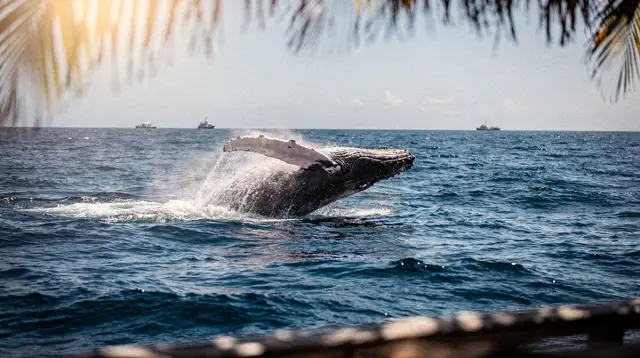
What the whales are actually doing in the channel matters for setting expectations. Pregnant females arrive first, give birth in the warm shallows, and spend weeks nursing calves that need to build blubber before the swim back north. Males, meanwhile, compete loudly and physically for access to receptive females — which is why breaches, tail slaps and pectoral fin slaps cluster so heavily around the peak months. None of this is a performance staged for boats; it’s the reason the animals are here at all, and it’s also why sightings can be dramatic one hour and quiet the next. A channel full of whales doesn’t mean a channel full of visible behavior every minute you’re watching.
Why the Auau Channel
Maui isn’t an arbitrary whale destination. The Auau Channel, the body of water between Maui’s west and south coasts and the islands of Lanai and Molokai, is shallow, relatively calm, and warm compared to open ocean — exactly the conditions humpback mothers want for calving and nursing. It’s considered one of the most important humpback whale habitats in the world, and much of it falls inside the Hawaiian Islands Humpback Whale National Marine Sanctuary. For background on why this channel in particular draws so many animals, our piece on the Auau Channel goes deeper into the geography.
Practically, this means whales aren’t a rumor or a lucky one-off sighting confined to a single beach. During peak months they show up along both the west coast (Lahaina, Kaanapali) and the south coast (Kihei, Wailea, Maalaea), because both border the same channel. Neither side of the island has a meaningful edge over the other for sightings — the difference between coasts is really about your base, your drive times and your other plans, covered in West Maui vs South Maui: where to stay.
Lahaina vs Maalaea: does the departure harbor matter?
Boats chasing whales leave from two main harbors, and the difference between them is really about geography, not whale density. Lahaina, on the West Maui coast, puts you closer to the northern reaches of the Auau Channel and to the deeper water off Kaanapali; it’s also the busier harbor, with more departures and more boat traffic to share the channel with. Maalaea, on the South Maui side, sits at the narrowest, shallowest part of the channel — often the shortest run out to open water — and shares its harbor with boats headed to Molokini for snorkeling, which is why some operators run a combined whale-watch-and-snorkel trip in season.
Neither harbor has a documented edge in sighting rates; the choice usually comes down to where you’re staying. Someone based in Kihei or near Wailea and Makena saves a drive by leaving from Maalaea, while a stay in Lahaina itself makes that harbor the obvious pick.
What whale season changes for your trip
If you’re planning dates around whale season, here’s the honest version of what it does and doesn’t affect.
It raises your odds of an unplanned sighting. During January through March, it’s genuinely common to spot a spout, a tail slap or a breach from a beach chair, a resort balcony facing the channel, or a car pulled over on the Honoapiilani Highway. You don’t need to book anything to encounter a whale in season — you need to be looking at the water. Our guide to whale watching from shore covers the specific pullouts and beaches where this happens most.
It makes a dedicated boat tour worth considering. If seeing whales up close is a goal rather than a hope, a boat gets you into the channel itself, often with a naturalist aboard who can read whale behavior and position the boat within the legal approach distance. That’s a separate decision from when to visit, and it’s covered by the tour guides linked above rather than here.
It does not shrink the rest of the island’s offer. This is the piece worth saying plainly: nothing else on Maui pauses for whale season. Snorkeling at Molokini, the drive to Hana, sunrise at Haleakala, surfing at Lahaina or Kihei, the farms of Upcountry — all of it runs exactly the same in July as it does in February. A trip planned for October, deep in the off-season for whales, isn’t a lesser Maui trip; it’s a trip built around different priorities, likely better snorkeling visibility and a quieter, less expensive island overall. See best time to visit Maui for how whale season fits into the island’s broader calendar of trade-offs.
It doesn’t overlap with storm risk. Whale season sits inside Maui’s rainy season (roughly November to April), but that’s a coincidence of Hawaii’s two-season climate, not a warning sign. The Central Pacific hurricane season runs June through November, entirely on the dry side of the year and with essentially no overlap with peak whale months. If you’re worried about weather risk, hurricane season on Maui and Maui weather by month are the right references, not whale timing.
Month-by-month: what to expect
| Period | Whale presence | What it means for planning |
|---|---|---|
| December | Building — early arrivals | Some sightings possible, especially by boat; shore sightings less reliable |
| January | High and rising | Strong odds from shore and boat; also the start of high-season crowds and prices |
| February | Peak | Best odds of the year; book boats and lodging early |
| March | Peak, tapering late in the month | Still excellent; slightly less crowded than January-February |
| April | Declining fast | Sightings possible early in the month, unlikely by the end |
| May–November | Essentially absent | No realistic expectation of a sighting; every other activity on the island unaffected |
Treat this as a trend, not a guarantee in either direction. Individual whales have shown up as early as October and as late as May in some years — rare, but it happens.
Booking around whale season without over-planning
A few practical notes for travelers weighing whale season against everything else on the calendar:
- Peak whale months are also peak tourist months. January through March overlaps with winter holiday travel and the general high season, so flights, rental cars and resort rooms cost more and book out earlier. If budget matters as much as whales, that trade-off is worth weighing against a shoulder month.
- A whale sighting isn’t the only reason to travel in winter. Winter also brings the biggest surf to Maui’s north shores (Hookipa in particular), lusher landscapes from the rain, and the cooler, more comfortable temperatures at higher elevations like Upcountry and the Haleakala summit — still around freezing at dawn regardless of season.
- If whales are a “nice if it happens” rather than the trip’s purpose, don’t rearrange your whole itinerary around them. Book your stay for the reasons that matter most to you — snorkeling conditions, price, crowd levels — and let whale sightings be a bonus if your dates happen to land in season.
- Spinner dolphins are a different animal on a different rulebook. They’re present in Maui’s bays year-round, not seasonally, but swimming with them is prohibited under a federal rule protecting their daytime rest in shallow bays — see spinner dolphin tours in Maui for what’s actually allowed.
Seeing whales without a dedicated tour
Because so much of the Auau Channel is visible from land, you don’t have to build your whole schedule around a boat departure to see whales in season. Good vantage points cluster along the coastal roads and beach parks of Lahaina, Kihei, Wailea and Makena, and the harbor town of Maalaea, which also happens to be the shortest boat run out into the channel. A morning coffee on a lanai facing the water, in the right months, is sometimes all it takes.
That said, a boat still offers something shore viewing can’t: sustained time on the water, distance covered, and often a naturalist narrating what you’re seeing. If a boat trip is part of your plan, a small-group outing like the Epic Small Group Whale Watch spends the whole excursion focused on finding whales, while a sailing option such as the Luxury Catamaran Whale Watch Sail or the Deluxe Whale Watching Sail with Lunch pairs the search with a full morning or afternoon on the water. None of these guarantee a whale — no honest operator will tell you otherwise — but they put you in the part of the channel where sightings are most likely during peak months. For a full comparison of routes and operators, see the dedicated guides linked earlier in this page.
If your trip lands outside whale season altogether, the same channel and coastline are still worth a sunset outing on general merit — a Sunset Cocktail Cruise off Lahaina works twelve months a year, whale or no whale, and a land-based option like the West Side Maui Highlight Tour covers the coast’s other draws when the channel is quiet.
Planning your dates around the whole trip
Whale season is one input among several when picking dates for Maui — alongside surf conditions, rain patterns, crowd levels and price. It’s worth reading it in context rather than in isolation. Our best time to visit Maui guide lays out the full year, and how many days you need in Maui helps size the trip once your dates are set. If a full itinerary built around a winter visit is useful, a one-day Maui highlights tour shows how whale watching can sit alongside the island’s other must-dos without dominating the schedule, and the whale and dolphin watching category rounds up every relevant activity in one place.
What to bring on a whale watching trip
Whale season falls squarely in Maui’s rainy season, but a day on the channel in December through April still calls for the same core packing logic as any other boat trip, adjusted for slightly cooler, windier conditions on the water. A layer that blocks wind is worth more in winter than a swimsuit — the channel crossing can be brisk even when the beach feels warm — and our what to wear on a sunset cruise guide covers the same layering logic that applies to a morning or afternoon whale watch.
Sun exposure is still a factor even on a cloudy winter day, and Maui County’s ban on oxybenzone, octinoxate and octocrylene sunscreens means only mineral, zinc-based sunscreen is legal to bring or use anywhere on the island, boats included — bringing a non-mineral product from home isn’t a workaround. For the fuller list of what belongs in a suitcase for any Maui trip, whale season or not, see the Maui packing list.
Frequently asked questions about Maui’s whale season
What months should I visit Maui to see whales?
Aim for January through March for the best odds. Whales start arriving in December and the last stragglers usually leave by late April, but the channel is busiest at the peak of winter.
Can I see whales from land in Maui, or do I need a boat?
Both work. Shoreline lookouts along West Maui and South Maui regularly produce sightings during peak months, though a boat gets you closer and for longer. Neither guarantees a sighting on any single day.
Is Maui still worth visiting outside whale season?
Yes. Snorkeling, hiking, the road to Hana, Haleakala sunrise and nearly every other activity on the island run year-round and are unaffected by whale season. Whales are a seasonal bonus, not the reason the island functions.
Do whales affect where I should stay on Maui?
West Maui (Lahaina, Kaanapali) and South Maui (Kihei, Wailea, Maalaea) both border the Auau Channel and offer comparable shore-viewing and boat-departure options during whale season. Neither coast is clearly better for whales alone.
Are whale sightings guaranteed on a boat tour during peak season?
No. Humpback whales are wild animals and sightings are never guaranteed, even at the peak of the season. Most operators report high sighting rates in January through March, but no honest operator promises a whale.
Does whale season overlap with hurricane season in Maui?
No. Whale season runs December to April, in Maui’s rainy season. The Central Pacific hurricane season runs June 1 to November 30, during the dry season. The two never overlap.
How close can boats and swimmers get to humpback whales in Maui?
Federal law sets minimum approach distances for boats and people around humpback whales in Hawaiian waters, and vessels are required to maintain them. This is enforced, not a suggestion, and it’s part of why sightings vary in duration.
Seasonal Maui activities on GetYourGuide
Verified deep-linked GetYourGuide tours. Book through these links and we earn a small commission at no cost to you.
GetYourGuide does not provide a product photo for this activity — the image shows the meeting point, photographed by us.