Whale Season in the Auau Channel
The first time I understood what the Auau Channel actually was, I was standing on the sand at Kaanapali, not on a boat. It was a January morning, and a plume of white spray went up maybe half a mile offshore, then another, closer. I did the thing every visitor does: I looked around for someone to confirm I hadn’t imagined it. A local guy walking his dog didn’t even turn his head. “They’re always out there this time of year,” he said, and kept walking. That offhand tone is, I think, the real story of whale season on Maui. For four months, something extraordinary becomes background noise.
The water he was pointing at isn’t the open Pacific. It’s the Auau Channel, a strip of sea maybe eight or nine miles across at its narrowest, boxed in by three islands: Maui to the east, Lanai to the southwest, Molokai to the northwest. On a map it looks almost like a lake with the lid left open at both ends. And that shape is the entire reason the whales are there.
Why this exact channel, and not the open ocean
Humpback whales spend their summers feeding in the cold, food-rich waters off Alaska, then swim roughly 3,000 miles to Hawaii to breed and give birth. They don’t feed here at all; there’s almost nothing for them to eat in these waters, and most arrive already carrying the fat reserves that will get them through the season. What they need instead is water that’s warm, calm, and shallow enough to be relatively safe from the open ocean’s bigger predators and rougher swell.
The Auau Channel fits that description better than almost anywhere else in the islands. It’s shielded from the direct swell of the North Pacific by Molokai to the north and Lanai to the southwest, so the water stays comparatively flat even when the outer coasts are getting hammered by winter storms. It’s also shallow by oceanic standards, generally under 300 feet, which matters enormously for a species that gives birth here. A newborn calf, still learning to coordinate its breathing with its mother, is safer in shallow, sheltered water than in the open channel between islands where currents run harder and depths drop off fast.
So the channel functions as a nursery, in the literal sense. Mothers arrive pregnant or already nursing, and this pocket of calm water between Maui, Lanai and Molokai is where a huge share of the North Pacific humpback population chooses to have and raise its calves for the first months of life.
What’s actually happening out there
Whale season here runs roughly December through April, with the density of animals peaking January through March. Outside that window, this channel is nearly empty of them; by May they’ve mostly begun the long swim back north, and by summer there are essentially none left in Hawaiian waters at all.
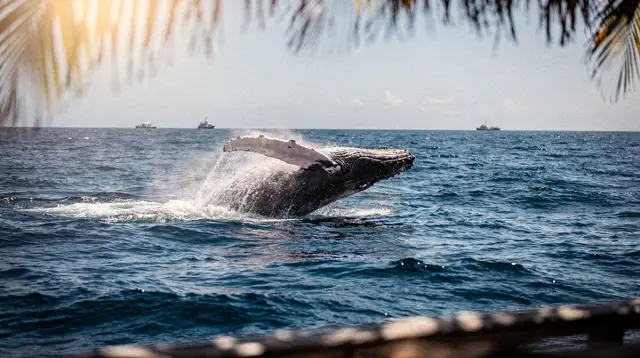
During the season, the behavior in the channel breaks down into a few recognizable patterns, and once you know them, distant spray starts to mean something specific. A mother and calf traveling together, often with a third adult male “escort” nearby, move slowly and surface predictably. Competitive groups, sometimes called heat runs, are the opposite: several males pursuing a female, moving fast, aggressive, and loud, sometimes with real collisions between the animals. Then there’s the display behavior everyone hopes to see: breaching, where an adult throws most or all of its 40-ton body clear of the water and lands with a crash you can hear from shore; pectoral slapping, where a whale rolls onto its side and slaps a fin the length of a small boat against the surface; and spy-hopping, where a whale rises vertically, head up, seemingly just to look around.
Humpbacks are also, famously, singers. The males compose long, structured songs that travel for miles underwater, and researchers believe the songs play some role in courtship or male-to-male communication, though nobody has fully settled why. What’s striking is how uniform a song is across an entire population in a given season, and how it slowly changes year to year, like a very slow-moving cultural trend passed between animals that never speak to each other except through water.
A recovery, not a constant
It’s worth remembering that none of this was guaranteed to still exist. Commercial whaling reduced the North Pacific humpback population to a small fraction of its historic size by the mid-20th century. Protection under U.S. and international law, starting in the 1960s and 70s, gave the population decades to rebuild, and the whales filling the Auau Channel today are the visible result of that recovery. It’s part of why a small-boat outing built around watching them feels different from most wildlife encounters: this is an animal that was nearly gone from these waters within living memory.
That history is also why the viewing rules exist. Federal law sets a minimum approach distance for boats and requires giving mother-calf pairs even more room, because a startled or harassed whale, especially one with a calf, can abandon a resting spot it needs. None of it is arbitrary caution; it’s the same logic that let the population come back in the first place.
Watching from land versus from the water
You don’t need a boat to witness any of this. The whole reason the channel became known as a whale-watching destination is that the animals come close enough to see from shore, particularly along the West Maui coast facing Lanai and Molokai, and along South Maui looking out past Maalaea. A pair of binoculars and a little patience at a beach or overlook facing the channel will often turn up a blow or a breach within twenty minutes during peak season, no reservation required.
Going out on the water changes the scale of it, though. From a boat in the channel itself, you’re inside the same body of water the whales are using, and the sound of a blow, or the impact of a breach landing, carries differently than it does from a hundred yards of sand and air. Boats operating here are required to follow the same distance rules that protect the animals from shore, so getting close is still ultimately up to the whales, not the operator.
Where to base yourself for the best odds
Where you stay changes what you’ll see without leaving the shore. Lahaina and the rest of West Maui look directly across the channel toward Lanai and Molokai, and most whale-watching boats leave from harbors along this coast — see how a Lahaina whale-watching tour compares to one departing from Maalaea, the harbor tucked between West and South Maui that also runs its own Maalaea whale-watching tour.
South Maui, from Kihei down to Wailea and Makena, faces the same channel from the other side, with a flatter, more sheltered stretch of water most mornings. If you’re choosing between the two coasts for your whole trip, not just for whale season, West Maui vs. South Maui: where to stay and Kaanapali vs. Wailea both cover the trade-offs. Whichever coast you pick, a shorter outing focused just on the channel is a reasonable first step if you’re not sure yet how much time you want to spend on the water.
Timing matters as much as location. Best time for whale watching on Maui and when to go for whale season both dig into the month-by-month odds in more depth than the range given above, and Maui weather by month explains what conditions look like outside whale season, if your dates fall before December or after April.
The rest of the channel isn’t empty either
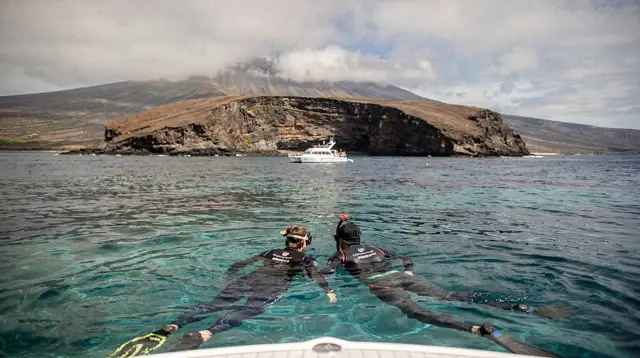
Whales share this water with other animals worth knowing about before you book anything. Spinner dolphins work the same coastline in resting pods, most visible early in the day; spinner dolphin tours on Maui explains where and when to look for them, whale season or not. The Molokini crescent sits at the edge of this same channel, and boats there often combine snorkeling with a stop to watch for whales along the way — a combined snorkel-and-whale-watching trip out to Molokini is how most people do both in a single morning. If you want to know how that crescent got there in the first place, how Molokini crater formed covers the geology behind it. The Auau Channel is also the same water crossed by the single ferry route between Maui and Lanai, the closest of the two islands boxing the channel in on the Lahaina side.
For picking a boat trip that matches the crowd, timing and comfort you want, best time of day for Molokini snorkeling and a Molokini snorkel tour from Maalaea or from Wailea walk through the differences by departure point.
Uncertainty is part of the deal
I’d be lying if I said every outing turns up a breach. Some days the channel is quiet, or the animals stay distant, surfacing only as a blow on the horizon. That unpredictability isn’t a flaw in the experience; it’s what makes it wildlife, not a show. What is close to certain, in season, is that something will surface somewhere in the channel while you’re looking. Whether it performs for you is the whales’ decision, not the boat’s.
Humpback Whales in the Auau Channel: Common Questions
Why is it called the Auau Channel?
Auau is the Hawaiian name for the channel separating Maui, Lanai and Molokai. It has no connection to any other island group; it refers specifically to this stretch of water.
Which months do whales occupy the channel?
Roughly December through April, with the highest numbers from January through March. Outside that window, sightings in the channel are rare to nonexistent.
Do the whales feed in the Auau Channel?
Generally no. Humpbacks do almost all their feeding in cold northern waters during summer and largely fast during their months in Hawaii, living off fat reserves built up before migrating.
How far do the whales travel to get here?
Most of the population that winters in Hawaii spends summer off Alaska, a migration of roughly 3,000 miles each way, one of the longest of any mammal.
Is it legal to swim or approach a whale in the water?
No. Federal regulations set minimum approach distances for boats and swimmers, with extra distance required around mother-calf pairs. Approaching closer than the legal limit is prohibited.
Can I see whales from shore without a boat?
Yes. The West Maui and South Maui coastlines both face the channel directly, and shore sightings during peak season are common with nothing more than patience and a clear view of the water.
Why do the whales come to this specific channel rather than elsewhere in Hawaii?
Its shallow depth and shelter from three surrounding islands make it calmer and safer than open water, which matters especially for mothers with newborn calves that need protected conditions.
Are the whales guaranteed to be visible on any given day?
No sighting is guaranteed. Whale behavior varies day to day, and while the channel holds large numbers of animals in season, how close or active they are on a given outing can’t be promised.
Seasonal Maui activities on GetYourGuide
Verified deep-linked GetYourGuide tours. Book through these links and we earn a small commission at no cost to you.
GetYourGuide does not provide a product photo for this activity — the image shows the meeting point, photographed by us.