What to Bring on a Molokini Snorkel Trip
What should I pack for a Molokini snorkeling trip?
Maui County bans the sale, distribution, and use of sunscreen containing oxybenzone, octinoxate, or octocrylene, so only mineral (zinc oxide) sunscreen is legal to wear on the water. Beyond that, pack a rash guard or reef-safe cover, a hat that straps on, motion sickness remedy taken before boarding, a dry bag, and cash for tips.
Packing for a morning in the Molokini channel
Molokini sits about 4 kilometers off Maui’s south shore, and no one steps foot on it — the crescent is a state marine reserve, and every visitor snorkels straight from the boat. That changes what belongs in a bag more than most first-time visitors expect. There is no beach to walk to, no shade tree, and no store once the lines are cast off from Maalaea or a slip in Wailea or Kihei. What you bring on board is what you have for the whole trip.
This page covers what to pack, not what to rent. Fins, masks, and snorkels are supplied by every operator or available separately through snorkel gear rental; the choice of departure port and morning-versus-afternoon timing is covered on best time of day for a Molokini snorkel and early morning vs. afternoon. Here, the focus is narrower: sunscreen, sun protection, seasickness prevention, and the small personal items that make the difference between a comfortable morning and a rough one.
Sunscreen: mineral only, by law, not by preference
This is the single most important item on the list, and the one most packing advice gets wrong by treating it as a suggestion rather than a rule. Since October 1, 2022, Maui County has banned the sale, distribution, and use of sunscreen containing oxybenzone, octinoxate, or octocrylene. That third word matters: this is not only a shelf restriction on local stores. Wearing a banned formula in county waters, including at Molokini, is itself against the rule, which means “I brought my own from home” is not an exemption if the label lists any of those three chemicals.
The only sunscreen that is unambiguously compliant is a mineral formula, meaning the active ingredient is zinc oxide, sometimes paired with titanium dioxide. These physically block UV rather than absorbing it chemically, and they are the only category the county law leaves untouched. A bottle labeled “reef safe” or “reef friendly” is a marketing phrase with no legal definition in Hawaii — some products carrying that label still contain octinoxate. Read the active ingredients panel, not the front label.
| What to check | Compliant | Not compliant |
|---|---|---|
| Active ingredient | Zinc oxide / titanium dioxide | Oxybenzone, octinoxate, octocrylene |
| Front label claim | Any wording, if ingredients check out | “Reef safe” alone is not proof |
| Format | Lotion, cream, stick, mineral spray | Aerosol chemical sunscreens |
| Where it’s used | Boat, water, beach, countywide | Nowhere in Maui County |
Pack a full-size tube rather than a travel sample — mineral sunscreen needs reapplication more often than chemical formulas, especially after time in salt water, and a two-hour snorkel stop plus deck time adds up faster than expected. Many Molokini operators now supply mineral sunscreen on board, sometimes included, sometimes at a station near the swim step, but availability varies by boat and by day, so bringing your own removes the uncertainty entirely.
a Molokini snorkel sail aboard a catamaran with a dedicated swim platform and most similar trips out of Maalaea run two to three hours round trip, which is long enough that sunscreen applied once at the dock will not be enough by the second stop.
Covering up instead of relying on sunscreen alone
The most reliable sun protection on a boat is fabric, not lotion, since nothing needs reapplying and nothing washes off at the first swim. A rash guard, long-sleeved if you burn easily, covers the shoulders and back that get the most direct sun during the ride out and the surface-swimming portion at Molokini itself. Board shorts or a swimsuit under the rash guard rounds out the layer, and many snorkelers now wear a full-length lycra suit for exactly this reason — it also happens to be one option operators suggest in place of chemical sunscreen for the parts of the body it covers.
A hat is worth bringing but needs a chin strap or a clip to survive the wind on an open deck; a hat that blows off on the way out is a hat you do not have for the ride back, and mid-channel retrieval is not something any boat will attempt. Polarized sunglasses with a strap serve the same purpose and make the glare off the water bearable during the crossing.
Sea turtles: look, don’t approach
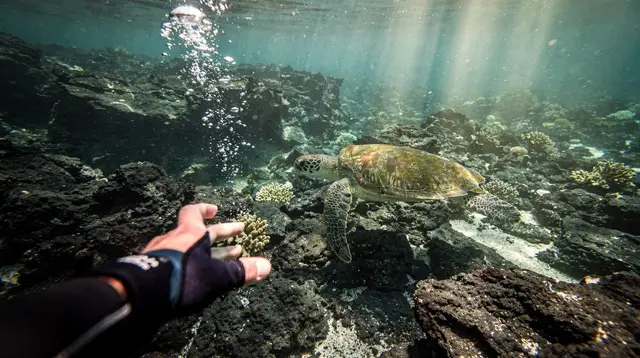
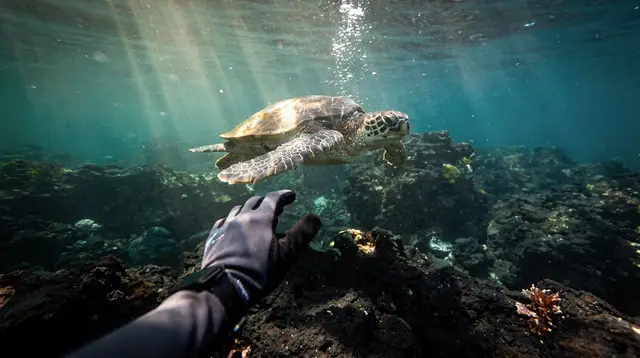
Molokini itself is a coral and fish site more than a turtle site — Turtle Town off Makena is the better bet for reliably seeing green sea turtles — but many Molokini tours add a second stop at Turtle Town or a similar reef, and turtles do occasionally pass through the crater itself. If one appears, the rule is simple and federal, not a local courtesy suggestion: keep a minimum distance of roughly 3 meters, about 10 feet, from any Hawaiian green sea turtle (honu). That distance holds in open water and increases if a turtle is resting or hauled out.
Nothing about packing changes this, but it changes what you should not pack a plan around: there is no product, fin kick, or camera lens substitute for keeping distance. Do not chase, do not touch, and do not position yourself between a turtle and open water. Crews will call this out if a swimmer drifts too close, and it is worth listening the first time. More on where sightings are most consistent is covered on best spots to see turtles in Maui.
Camera gear: what actually survives a snorkel boat
Molokini’s water clarity is one of the main reasons people book the trip in the first place, and it is tempting to bring every piece of electronics owned. A few things are worth the space in a dry bag, and a few are not. A waterproof phone case rated for snorkeling depth (not just splashes) covers most casual photo needs, since modern phone cameras handle the shallow, bright water around the crater rim well. A dedicated underwater camera or a GoPro-style action camera with a wrist strap or chest mount does better in the deeper, darker sections of the crater wall where a phone’s screen becomes hard to see anyway. Bring a spare battery or a full charge rather than counting on the boat for power — most operators have no charging outlets for passengers, and a dead battery an hour into a two- to three-hour trip is not fixable on board.
Whatever camera comes along, a floating wrist strap or lanyard is worth more than the camera itself: gear that slips from a hand in open water over a 100-plus-meter-deep channel is gone, not just dropped. Leave anything not rated for water — a regular point-and-shoot, an unprotected phone — in the dry bag rather than out on deck, since spray reaches areas that look sheltered on a moving boat.
How the season changes the packing list
Maui’s two seasons affect a Molokini trip less than they affect a beach day, but not zero. During the dry season, roughly May through October, mornings are calm more often and a light layer is rarely needed beyond the rash guard already recommended for sun. In the wetter months, November through April, trade winds and passing showers make the crossing choppier on average, which is another reason the seasickness precautions above matter more, and a light windbreaker or extra layer for the ride out is worth having even though the crater itself stays warm. Month-by-month specifics, including which weeks tend to run calmest, are covered on Maui weather by month.
The Pacific hurricane season runs June 1 through November 30, and while a direct hit on Maui is rare, tropical systems passing at a distance can still churn up the channel enough that operators cancel or reroute trips; if a storm is anywhere in the forecast during a fall or early-summer visit, it’s worth reading hurricane season in Maui before finalizing packing or timing. Winter visitors, roughly December through April, sometimes get an unplanned bonus on the crossing itself: humpback whales pass through the same channel Molokini boats cross, and a fluke or a breach in the distance is common enough that it’s worth keeping a camera accessible rather than packed away, a detail covered further on whale season in Maui.
Motion sickness: prevent it, don’t try to treat it
The channel between Maui and Molokini has open water and can get choppy, especially as the trade winds build through the morning — one of the reasons early departures see calmer conditions than afternoon trips. Seasickness is the most common reason a snorkeler ends up sitting out the very stop they booked the trip for, and it is far easier to prevent than to reverse once symptoms start.
Whatever remedy you use — an over-the-counter tablet, a prescription patch, or an acupressure wristband — take or apply it before boarding, not once the boat is underway and the stomach has already started to turn. Eating a light meal beforehand and avoiding a completely empty stomach also helps; alcohol the night before does not.
The rest of the bag
| Item | Why it matters |
|---|---|
| Mineral sunscreen (zinc oxide) | Legally required formula in Maui County waters |
| Rash guard or cover layer | Reduces how much sunscreen you need and how often |
| Hat with a strap, polarized sunglasses | Wind on deck takes an unsecured hat overboard |
| Motion sickness remedy | Taken before boarding, not after symptoms start |
| Reusable water bottle | Sun and salt water dehydrate faster than expected |
| Light towel | Boats have limited covered storage |
| Dry bag or plastic bag | Keeps a wet swimsuit off dry clothes for the ride home |
| Cash, small bills | Crew tips are customary and cards aren’t always workable underway |
| Underwater camera or phone case | Optional, but Molokini’s visibility is often the day’s best |
| Light snack | Some tours include breakfast or lunch; check before packing food |
Leave valuables in the car or the hotel safe rather than in a bag on deck — a Molokini boat has open rails and moving spray, not a lockable cabin for every passenger’s belongings. If your tour is one of the longer options with meals included, such as a full-morning Molokini sail that serves breakfast and lunch on board, you can skip packing food but should still bring your own water bottle to refill.
Choosing between a quick trip and a longer one
Shorter two-hour options, like a compact express snorkel run out to the crater, mean less time exposed to sun and swell, which is worth factoring in if seasickness or sunburn are concerns. Longer combination trips that add a second reef, such as a combined Molokini and Turtle Town snorkel outing from Kihei, mean more sun exposure over a longer window and make the case for reapplying mineral sunscreen partway through rather than relying on a single morning application.
None of this replaces reading the specific operator’s listing before departure — some boats supply masks, fins, sunscreen, and towels, others expect passengers to bring their own, and the difference is usually spelled out in the tour description rather than assumed. For anyone still deciding on gear rental rather than packing their own mask and fins, that question is answered separately on snorkeling gear rental in Maui, and the departure port itself — Maalaea versus Wailea — affects both the length of the crossing and how early you’ll need to arrive.
Molokini packing questions, answered
Can I bring my own sunscreen on a Molokini snorkel tour?
Only if it is mineral, meaning zinc oxide or titanium dioxide as the active ingredient. Maui County’s law bans oxybenzone, octinoxate, and octocrylene from sale, distribution, and use countywide, so a chemical sunscreen brought from home is not a workaround.
Do Molokini boats provide sunscreen?
Many do, as a mineral sunscreen station or a spray included in the price, but not all. Check the operator’s listing before the trip, and pack your own mineral tube as a backup regardless.
How close can I get to a sea turtle at Molokini?
Federal law sets a minimum distance of about 3 meters (10 feet) from Hawaiian green sea turtles. It applies in the water as much as on a beach, and it is the guide’s job to enforce it, not just the swimmer’s choice.
What should I wear under my snorkel gear?
A rash guard or a full-length swim layer covers more skin than sunscreen alone and cuts down on how much you need to reapply. Board shorts or a one-piece under a rash guard is the standard combination on Molokini boats.
Should I take motion sickness medication before a Molokini trip?
Yes, and before boarding, not after symptoms start. The channel between Maui and Molokini can be choppy, and remedies work far better as prevention than as treatment once nausea has set in.
What should I bring to dry off and store wet gear?
A dry bag or a plastic bag for a wet swimsuit, a light towel, and a change of clothes for the ride back. Most boats have limited covered storage, so keeping your own gear contained matters more than it sounds.
Do I need cash on a Molokini snorkel boat?
Cash is useful for crew tips, which are customary and usually not included in the tour price. Card readers are not always available once the boat is underway.
Molokini snorkel cruises on GetYourGuide
Verified deep-linked GetYourGuide tours. Book through these links and we earn a small commission at no cost to you.
GetYourGuide does not provide a product photo for this activity — the image shows the meeting point, photographed by us.