Family-Friendly Snorkel Tours in Maui
Which Maui snorkel tours work best for families with kids?
Shorter sails with calmer, more sheltered water and a slide or easy step-in entry tend to suit swimming-age kids best. Longer open-ocean crossings to sites like Molokini or Lanai ask for more comfort in rougher water and should be judged by how your child handles waves and boat motion, not by age alone.
Matching the boat to the kid, not the other way around
Every brochure on Maui calls its snorkel trip “family-friendly.” Most of them mean it, in the sense that children are welcome aboard and gear comes in smaller sizes. What the label does not tell you is whether a particular child will actually enjoy a particular boat — and that depends less on age than on how comfortable that child is in open water, how they handle a rocking deck, and how long they can stay interested once the initial excitement of jumping in wears off.
This guide does not set an age cutoff, because none exists that applies across the island. Instead, it separates the general category of family snorkel trips into two rough groups: outings that stay closer to shore, in calmer and more sheltered water, and outings that cross open ocean to reach a specific site. Both can work well for families. They ask different things of the kids on board.
For toddlers and non-swimmers, see Best Maui Activities for Toddlers and Young Children, which covers activities built around that age group specifically. For teenagers who want more adventure than a beginner snorkel trip, Maui with Teenagers: What to Do is the better starting point. And if your family is set on the two most requested snorkel destinations — Molokini and Turtle Town — the category pages Molokini snorkel cruises and Turtle Town snorkeling go into the operational detail this page does not repeat.
Where you’re staying also shapes which boats are convenient. Most South Maui family boats leave from the harbor at Maalaea, which sits roughly between Kihei and the West Maui side and is the departure point for many Molokini trips. Families based in Wailea or Makena are closer to Turtle Town and to kayak-launch beaches along that stretch of coast. On the West Maui side, boats out of Lahaina and Kaanapali tend to run coastal sunset sails rather than open-channel crossings, which fits the calmer category below. None of this changes what a tour involves once you’re on the water, but it does change how early you need to leave the condo.
Calmer, more sheltered options
A number of Maui operators run shorter sails that stay within protected coastal water rather than crossing the open channel. These trips generally involve less boat motion, a shorter total time on the water, and an easier in-water experience for kids who are still building confidence.
One example built specifically around this kind of outing pairs a snorkel stop with a slide off the boat and a sunset return — a format that keeps kids engaged even if the underwater portion runs shorter than an adult-focused trip. You can look at the sunset sail that combines snorkeling with a water slide off the boat as one option in this calmer category.
Kayak-and-snorkel combinations along the South Maui coast are another way to keep things closer to shore. These trips paddle out from the beach rather than motoring into open water, which means the group controls the pace and can turn back more easily if a child gets tired or uneasy. The kayak and snorkel outing along the West Maui coast near Ukumehame follows this shape, staying in nearshore water rather than crossing a channel.
Tours built around a fixed schedule of gear fitting, in-water guidance, and a shorter swim window can also suit kids who do better with more structure and clearer instructions. The guided snorkeling tour with equipment and an instructor fits this pattern, with more one-on-one attention in the water than a large open-boat trip typically offers.
If you’d rather skip a boat entirely for a first outing, Best Snorkeling Beaches Near Kaanapali and Honolua Bay Snorkeling Guide cover shore entries where a nervous swimmer can wade out gradually and turn back at any point — useful for gauging comfort before booking a boat trip that can’t simply pull over. For families weighing cost against experience, Budget Snorkeling Options in Maui and Snorkel Gear Rental in Maui cover renting your own masks and fins for a shore day instead of paying per person on a boat.
Trips that cross open water
The best-known Maui snorkel destinations — Molokini crater and Turtle Town off Makena — both require a boat crossing through open channel water to reach. That crossing is where the experience diverges most from a sheltered coastal sail: the water can be choppier, the ride takes longer, and seasickness becomes a real factor for anyone prone to it, adults included.
None of this makes these trips off-limits for families. Many kids do perfectly well on them, especially children who are already confident swimmers and have some experience being on boats. But it is worth being honest with yourself about your own child’s tolerance for motion and for a longer stretch without a break, rather than assuming that “family-friendly” marketing means every child will have an easy time.
If your family decides a Molokini crossing is the right call, the Molokini snorkeling adventure departing from South Maui is one option that runs this route. For a trip built around the chance to see green sea turtles at the Turtle Town site off Makena, the Turtle Town kayak and snorkel tour combines a paddle with a swim at a site known for turtle sightings — though as with any wildlife encounter, nothing is guaranteed, and the trip is worth booking for the outing itself, not for a promised sighting.
For families weighing the differences in more depth, Turtle Town Snorkel Boat Tour from Makena and Molokini Snorkel Tour from Maalaea: What to Expect cover the specifics of each route, including where boats depart from and how the two experiences compare.
Molokini itself is worth a word of explanation for curious kids: it’s the crescent-shaped remains of a volcanic crater, partly collapsed and now sitting mostly below the waterline, which is why the water inside it is so clear and calm compared to the open channel crossing to reach it. How Molokini Crater Formed covers the story in more detail if your family likes a bit of context before or after the trip. Timing also matters for visibility and crowding — Best Month to Visit Maui for Snorkeling and Molokini Snorkel: Early Morning vs. Afternoon both affect how calm the crossing feels, which matters more for a family with kids than for adults snorkeling alone.
What to actually compare before booking
Rather than relying on an operator’s own “family-friendly” description, a few concrete questions tend to matter more:
| Question | Why it matters |
|---|---|
| Does the route stay near shore or cross open channel water? | Open crossings mean more motion and a longer stretch without an easy way to turn back |
| What flotation gear is provided for kids? | Vests and pool noodles vary by boat; ask if your child needs more support than a standard vest |
| How long is the total time on the water? | A longer trip asks more patience from a child who tires of the boat once the swimming is done |
| Is there a step-in entry, ladder, or slide? | Getting in and out of the water confidently matters as much as the swimming itself |
| What is the guide-to-swimmer ratio? | More attention in the water helps a child who is still building confidence |
None of these questions have a universally right answer — they depend on your own child. But asking them of a specific tour, rather than trusting a general “family” label, is what actually predicts whether the day goes well.
The sea turtle distance rule, and why it matters for kids
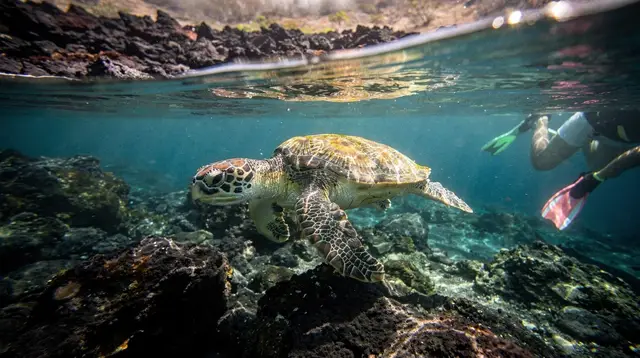
Green sea turtles, or honu, show up regularly around several Maui snorkel sites, including Turtle Town and stretches of the South Maui coast. They are a highlight for most kids who see one. They are also protected under federal law, which requires staying at least 3 meters (10 feet) away from a sea turtle at all times — more when a turtle is resting on land.
This is worth explaining to kids before they get in the water, not after a guide has to intervene. Excited children are the ones most likely to swim straight toward a turtle without thinking about distance, and a good guide will remind the group of the rule but cannot watch every swimmer every second. Setting the expectation on the boat, before anyone is in the water, tends to work better than a correction mid-swim. For more on where sightings are most likely, see Best Spots to See Turtles in Maui, and Sea Turtle Viewing Distance Law in Maui for the full detail behind the rule if a curious kid asks why the limit exists at all.
Sun protection is not optional
Maui County bans the use — not just the sale — of sunscreen containing oxybenzone, octinoxate, or octocrylene, a rule in effect since October 2022. This applies to everyone in the water, kids included, and “we brought our own from home” is not an exception if that sunscreen contains a banned chemical.
Pack a mineral, zinc-based sunscreen for the whole family before the trip. Many boat operators sell or provide reef-safe options, but supply is not guaranteed, and reapplying reef-safe sunscreen before boarding is simpler than sorting it out on deck. A rash guard for kids cuts down on how much sunscreen reapplication is needed mid-trip, which matters on a boat where getting back in the water quickly is part of the appeal. Maui’s Reef-Safe Sunscreen Law, Explained covers why the county banned these chemicals in the first place, which is worth reading before you pack rather than after a bottle gets confiscated at the dock.
Seasickness and the boat ride itself
For many families, the boat ride causes more trouble than the snorkeling. Kids who have never been on an offshore boat before do not always know how their stomach will react, and open-channel crossings toward Molokini or Lanai involve more motion than a coastal sail.
If seasickness is a concern, treat it before boarding rather than waiting to see what happens — motion sickness remedies work far better as prevention than as a cure once symptoms start. Sitting toward the center of the boat, where motion is felt less, and keeping eyes on the horizon rather than a phone screen can also help on the ride out.
Choosing between a short sail and a full-day trip
Some family snorkel options run as a half-day trip with a single stop; others combine two snorkel sites, a lunch break, and a longer day on the water. A longer trip is not automatically a better one for a family with young kids — more time on a boat means more time for a child to get bored, cold, or seasick, even if the extra site adds real value for older kids or adults who snorkel confidently.
Weigh the day against your own family’s rhythm. A shorter, calmer outing that ends with everyone still having a good time is generally a better outcome than a longer, more ambitious trip that ends with a tired, overstimulated child an hour before it’s over.
If snorkeling isn’t the right fit yet
Not every kid is ready to put a mask underwater, and that’s fine — the water off Maui has other ways in. Kayak Tours in South Maui and renting a stand-up paddleboard both let a family stay on top of the water while still getting close to the coastline, and either can be a gentler warm-up before a snorkel mask goes on for the first time. For turtles specifically without any swimming required, Turtle Town Snorkeling from Shore covers a wade-in alternative to the boat trip described above. And in winter, Whale Watching from Shore in Maui is worth combining with a beach day — humpback whales are visible in the Auau Channel without ever getting in a boat, which can make for an easier morning than a full snorkel charter if kids are tired from travel.
Building the rest of the day, or the trip, around it
A morning snorkel charter usually means a slow afternoon afterward — sun and salt water are tiring for kids in a way that doesn’t always show up until later. If you’re still shaping a full itinerary around a family snorkel day, Four Days in Maui: Family, Beach, and Snorkel, Five Days in Maui with Kids, and Five Days in Maui: Snorkeling-Focused each build a realistic pace around a boat trip or two rather than stacking a snorkel morning on top of a full afternoon of driving.
Frequently asked questions about family snorkel tours in Maui
Is there a minimum age for snorkel tours in Maui?
This varies by operator and boat, and no single age applies across the island. Check the specific tour’s own policy before booking rather than assuming a family-friendly label means all ages are welcome.
How long do family snorkel tours in Maui usually run?
Duration varies widely by boat and route, from shorter sails near the coast to longer trips that cross open water to sites like Molokini or Lanai. Read each tour’s own itinerary rather than assuming a typical length.
Do we need swimming experience to go snorkeling in Maui?
Basic comfort in the water helps on every tour, and it matters more on trips that cross open ocean to reach a site. Boats generally provide flotation vests and gear, but a child who is not yet a confident swimmer will have an easier time on a calmer, more sheltered outing.
Can we get close to sea turtles on a snorkel tour?
Sightings are common in several parts of Maui but never guaranteed. Federal law requires staying at least 3 meters (10 feet) from green sea turtles at all times, and guides will remind swimmers of this distance if turtles appear.
Are boat trips to Molokini or Lanai suitable for young kids?
These trips cross open channel water, which can be rougher and involves more boat motion than a coastal outing. They can work well for kids who are comfortable swimmers and used to being on a boat, but they are a different experience from a short, sheltered sail and are worth judging against your own child’s comfort level.
What should we bring on a family snorkel tour?
Reef-safe mineral sunscreen is required in Maui County, since sunscreen containing oxybenzone, octinoxate, or octocrylene is banned from use, not just from sale. A rash guard, a hat for the boat ride, and motion sickness precautions for anyone prone to seasickness are also worth packing.
Do family snorkel tours include gear and instruction for kids?
Most tours that market themselves to families provide masks, snorkels, fins, and flotation aids sized for children, along with some in-water guidance. Confirm this with the specific operator, since equipment ranges and instructor ratios differ from boat to boat.
Family-friendly activities on GetYourGuide
Verified deep-linked GetYourGuide tours. Book through these links and we earn a small commission at no cost to you.
GetYourGuide does not provide a product photo for this activity — the image shows the meeting point, photographed by us.