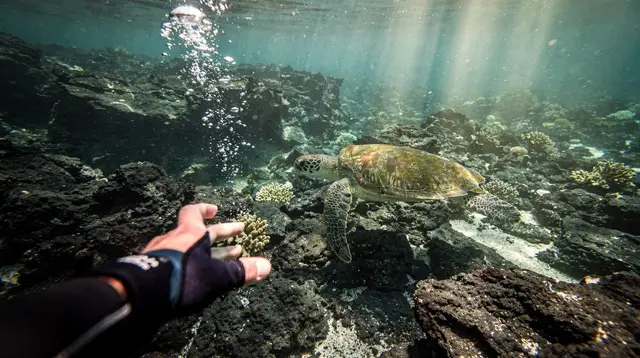
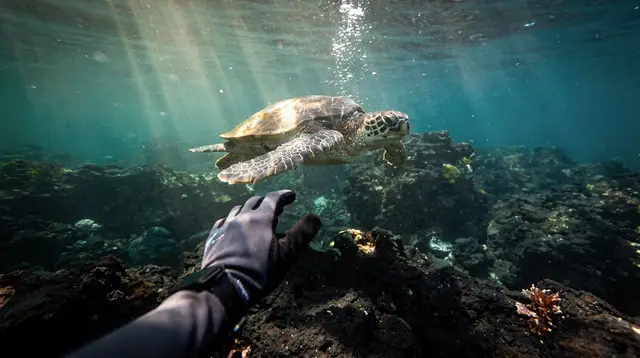
Turtle Town Snorkeling From Shore: The Self-Guided Makena Entry
Can you snorkel with turtles at Turtle Town from the shore, without a boat?
Yes, from the Makena shoreline near Maluaka Beach, but it is a longer swim over open, sometimes surgy water, best attempted only when the ocean is calm and you have your own mask, fins and snorkel. It is not the same experience as a boat drop, and the federal 3-meter distance rule for green sea turtles applies exactly the same whether you swim out from the sand or roll off a hull.
Getting Into the Water at Turtle Town
Turtle Town is a stretch of reef off the Makena coast in south Maui, named for the green sea turtles that feed there in reliable numbers. Most visitors reach it on a boat out of Maalaea or Kihei, and that boat trip is covered on its own page. This one is for a different traveler: someone with their own mask and fins, or a rental set from town, who would rather swim out from the sand than book a charter and work around its schedule.
That choice is real, but it is not the easier version of the same experience. A shore swim to Turtle Town means open water, no crew watching for boat traffic, and a longer distance than the calm, protected snorkel coves most people picture when they hear “beach entry.” This guide covers where to go in, how to judge whether the water is fit for it that day, what to bring, and the one rule that does not bend just because you walked in instead of rolling off a hull.
Where the Shore Entry Actually Is
The commonly used entry point sits at Maluaka Beach, on the Makena coast south of the big Wailea resorts and north of Big Beach. A small public parking area serves the beach, and it is the same general stretch some maps label as the Makena Landing area. There is no official trailhead, no rope line, and no sign marking “Turtle Town starts here” — you swim south and offshore, following the rocky shoreline and the reef structure, until you reach water where turtles are typically resting or grazing on algae.
Because there is no marked route, local knowledge and a bit of trial matter more here than at a groomed snorkel beach. Turtles move with the tide and the growth of algae on the rocks, so the exact spot shifts day to day. This is also why boat operators, who reposition daily based on where turtles were seen that morning, often find them faster than a swimmer working from a fixed entry point can.
Reading Ocean Conditions Before You Go In
This is the section that separates a good outing from a bad one. Makena’s coastline faces open ocean with no reef or headland to block swell, and conditions here change with the season and the hour:
| Condition | What to check | Why it matters for a shore swim |
|---|---|---|
| Wind | Trade winds typically build by late morning | Chop reduces visibility and makes the swim back harder |
| Swell direction | South swells (common in Maui summer) hit this coast directly | Even a small south swell turns Turtle Town’s approach rough |
| Current | No lifeguard station at Maluaka Beach | Currents run along this shoreline and are not monitored in real time |
| Visibility | Best in calm, glassy morning conditions | Murky water after rain or wind makes turtles harder to spot and each other harder to see |
If the surface has whitecaps, if you cannot see a clear sandy or reef bottom from the beach, or if you are not a confident distance swimmer, this is not the day for it. There is no boat crew here to pull you out if you tire halfway to the reef.
What You’ll See, and What You Won’t
Green sea turtles (honu) are the draw, and sightings from shore are common but not guaranteed on any single visit — the same honesty that applies to the boat tour version of Turtle Town applies here. You may also see parrotfish, needlefish, the occasional eagle ray over sandy patches, and healthy coral structure in spots the boats do not always stop at because it lies closer to shore.
What you generally will not get from a shore swim: the depth range and reef variety of a proper Molokini crossing, calm conditions guaranteed by picking the best hour of the day (a boat can leave at 6:30 a.m.; a self-driving swimmer usually cannot), or a crew pointing out exactly where the turtles are resting that morning. It is a DIY version of a spot most visitors see with help.
The Legal Distance Rule Applies From the Sand Too
It is worth stating plainly, because the ease of a shore entry can make people forget it: the federal minimum viewing distance for a green sea turtle is 3 meters (about 10 feet), and it does not change based on how you got in the water. A swimmer who walked in from Maluaka Beach has exactly the same legal obligation as a passenger who stepped off a charter boat. Approaching a resting or feeding turtle closer than that, chasing one that moves away, or touching one is against the law regardless of the vantage point you started from — see the fuller explanation in this rundown of the sea turtle viewing distance law. The rule exists because turtles that are repeatedly crowded stop resting and feeding normally; a shore swim being unsupervised is a reason to be more careful about distance, not less.
Gear to Bring vs Gear to Rent
Because there is no rental kiosk on Maluaka Beach itself, gear needs to be sorted before you drive down. Options, roughly in order of convenience:
- Bring your own mask, snorkel and fins if you own or travel with a set — by far the simplest option for a shore swim with no support crew nearby.
- Rent in Kihei or Wailea the day before or the same morning; see where to rent snorkel gear on Maui for what a basic set costs and what condos already provide.
- Reef-safe sunscreen only. Maui County has banned the sale, distribution, and use of sunscreens containing oxybenzone, octinoxate, or octocrylene since October 2022 — read the full explanation of the reef-safe sunscreen law if you are packing from home, since many drugstore sunscreens are not compliant. A rash guard covers more skin than sunscreen alone and holds up better on a longer swim.
- A dry bag or floating pouch for keys and a phone, since there is no boat deck to leave belongings on.
Parking, Access Points, and Facilities
Maluaka Beach has a small public parking lot that fills by mid-morning on clear days, particularly in the dry season from May to October. There are basic restrooms but no lifeguard tower and no beach concession. Remember that Hawaii law makes every beach public up to the high-water mark, including the stretch fronting Makena’s resorts, so access itself is never restricted — the limiting factor here is parking capacity and how far you are willing to walk if the lot is full.
This same coastline continues south to Big Beach and Little Beach, which are separate parking stops with their own access points and their own hazards (Big Beach’s shorebreak in particular). Do not confuse the three; a shore swim to Turtle Town starts at Maluaka, not at Big Beach’s main lot.
Best Time of Day and Season
Morning wins here for the same reason it wins at Molokini: wind. Trade winds on this coast typically strengthen through late morning and into the afternoon, so a swim started before 9 or 10 a.m. usually means calmer water and better visibility than the same swim attempted at 1 p.m. See the best time of day for Molokini snorkeling for the same wind logic applied to the boat-accessed crater a few miles offshore — the pattern holds along this whole stretch of south Maui coast.
Seasonally, the calmer summer months (roughly May through September) tend to be more forgiving for a shore swim than winter, when south swells are more frequent and whale-watching season also brings more boat traffic to the general area. None of this is a guarantee; check conditions the morning of, not the week before.
Comparing Shore Access to a Boat Trip
Both approaches reach the same reef. The trade-offs are different enough to spell out directly:
| Shore swim from Maluaka Beach | Boat tour | |
|---|---|---|
| Cost | Free beyond gear and gas | Paid tour, typically half-day |
| Distance to turtles | Variable, can be several hundred meters of open swim | Boat repositions to where turtles were seen that morning |
| Supervision | None | Crew in the water and on deck |
| Best for | Confident open-water swimmers with their own gear | Most visitors, families, less experienced swimmers |
| Weather flexibility | You judge conditions yourself, no refund if you turn back | Operator cancels or relocates for safety |
If the idea of a longer, unsupervised swim gives you pause, a guided option removes the guesswork. a small-boat outing to Turtle Town that includes underwater photos and video of the swim puts you in the water at the right spot without the open-water approach, and a crew member is nearby the whole time.
For a slower, paddle-first approach that still starts from land rather than a harbor, a clear-bottom kayak and snorkel tour departing from Makena lets you scout the water from above before getting in, which some self-guided swimmers find useful even if they plan to swim on their own another day.
Those who want to see Turtle Town alongside Maui’s better-known crater in one outing can look at a combined half-day trip covering both Molokini crater and Turtle Town, which trades the DIY flexibility of a shore swim for two stops in a single morning.
And for calmer water and warmer light without an early wake-up, a late-afternoon kayak cruise through Turtle Town is worth comparing against a self-guided evening swim, since wind and glare both tend to work against shore swimmers by that hour.
Safety Notes for a Self-Guided Swim
- Go with a buddy. There is no lifeguard at Maluaka Beach and no crew watching the water.
- Check conditions in person before entering — a beach that looks calm from the parking lot can have a stronger current once you are past the shallows.
- Do not swim to Turtle Town at dusk or after dark; light drops fast and the swim back gets disorienting.
- Keep the 3-meter distance from any turtle you find, in the water and if one hauls out to rest on a rock — approaching a basking turtle on the shoreline rocks is just as much a violation as crowding one underwater.
- Turn back if you tire. The swim back against wind or current is harder than the swim out.
- Skip this entirely in the days right after heavy rain, when runoff can cloud the water and increase bacteria levels along this coast.
For a broader look at where else on the island turtles show up reliably — some from shore, some only reachable by boat — see the overview of the best spots to see turtles on Maui. And for snorkeling elsewhere on the island when Makena’s swell is not cooperating, Honolua Bay on the west side and the beaches around Kaanapali are worth having as a backup plan.
Turtle Town From Shore: Common Questions
Where exactly do you enter the water for a shore swim to Turtle Town?
Most self-guided swimmers enter from Maluaka Beach (also called Makena Landing area, south end) in Makena, then swim south and offshore toward the rocky point where the reef drops off. There is no marked trail or buoy line; it is open-water swimming, not a shore snorkel with a guide.
How far is the swim from the beach?
Figure a round trip of several hundred meters each way depending on exactly where turtles are feeding that day, more than most casual snorkelers expect from a beach outing. It is a workout, not a dip.
Do I need my own gear, or can I rent nearby?
Bring your own mask, snorkel and fins if you have them; rental counters exist in Kihei and Wailea but none sit directly on Maluaka Beach, so you would need to gear up before driving down.
Is the shore swim safer or easier than a boat tour?
No. A boat drops swimmers close to where turtles are actively seen that day and a crew watches the water; a shore swim depends entirely on your own fitness, judgment of conditions, and navigation. It suits confident open-water swimmers, not beginners.
Does the 3-meter turtle distance rule still apply if I swim from shore?
Yes, without exception. The federal minimum distance from a green sea turtle is the same 3 meters (10 feet) whether you reached the water by boat or by walking in from the sand. Easy access does not change the law, and it does not matter whether the turtle is swimming or hauled out resting on the rocks.
What time of day gives the best visibility for a shore swim?
Morning, generally before 10 or 11 a.m., before the trade winds pick up and chop the surface. The same wind pattern that pushes boats to leave Maalaea early, as covered in the best time of day for Molokini snorkeling, affects shore swimmers on this stretch of coast just as much.
Can I combine the shore swim with parking at Big Beach or Little Beach?
Maluaka Beach has its own small public lot; it is a separate stop from Big Beach (Oneloa) and Little Beach further south along the same Wailea and Makena coastline. Plan them as different parking stops even though all three sit within a short drive of each other, and note that this rule about public beach access, explained in this piece on Hawaii’s public beaches, is what keeps Maluaka’s access open despite the resorts nearby.
Is a shore swim to Turtle Town worth it compared to just booking a boat?
It depends on your swimming ability and your budget. A confident open-water swimmer with their own gear can reach the same reef for free and on their own schedule. Anyone less sure of a long swim in open water, or traveling with kids, is better served by a boat that repositions to the turtles and has a crew in the water, even at the cost of a fixed departure time.
Turtle Town snorkeling on GetYourGuide
Verified deep-linked GetYourGuide tours. Book through these links and we earn a small commission at no cost to you.
GetYourGuide does not provide a product photo for this activity — the image shows the meeting point, photographed by us.